

STEINS;GATE
How many times will you travel back into the past to save the ones you love?
OVERVIEW
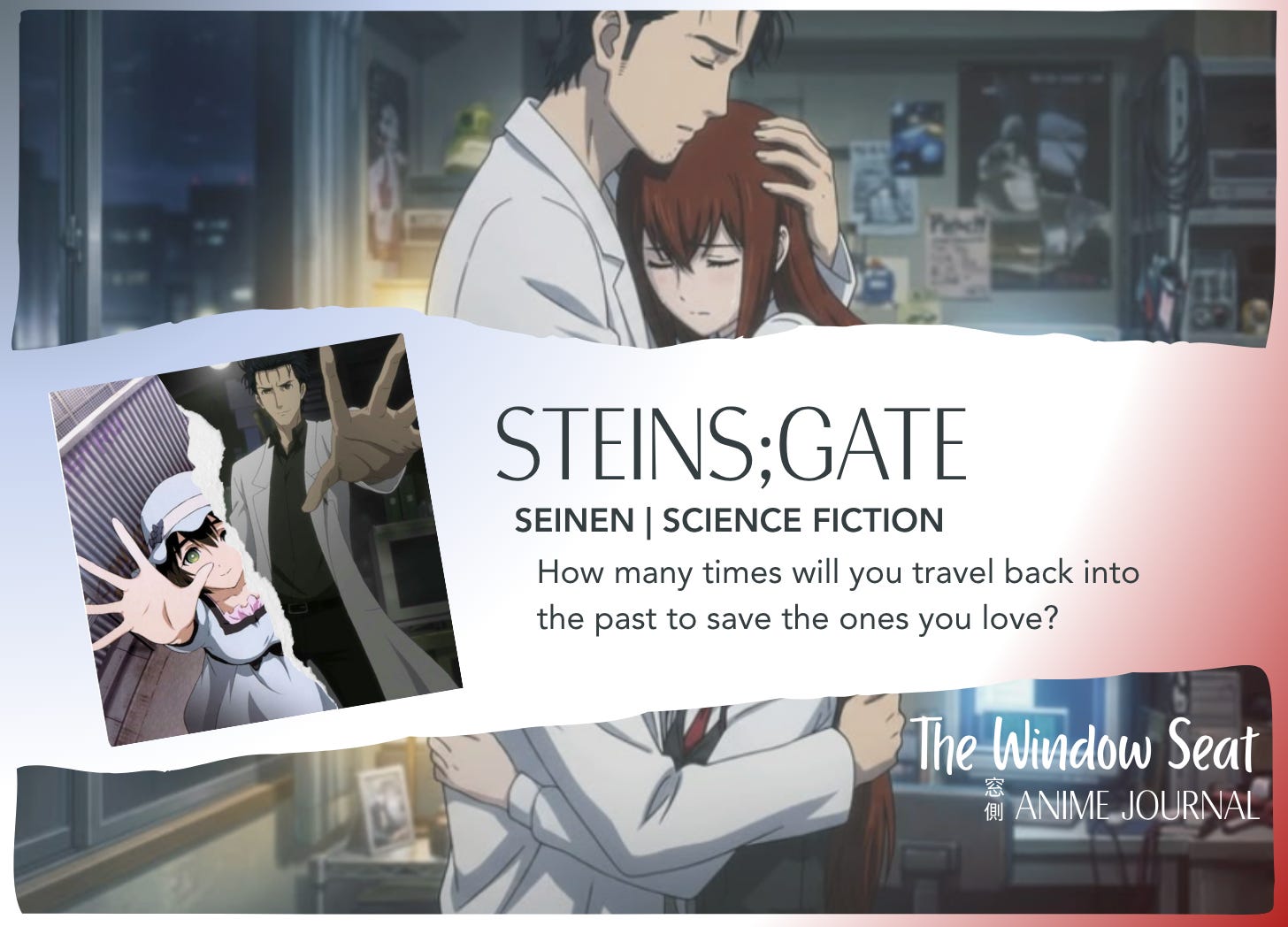
Nothing in Steins;Gate is what it appears at first glance.
Rintaro Okabe, a maniacally laughing mad scientist who talks in code about a fictional Organization no one else can perceive, is also a uniquely gifted physicist capable of time travel.
Itaru “Daru” Hasida, a chubby computer geek with a penchant for maid cafes, is also a hacker capable of breaking into the systems of global organizations.
Kurisu Makise, a young prodigy physicist, is like Schroedinger’s cat, both murdered in one moment, but then not murdered in another.
And Mayuri Shiina, a childhood friend of Okabe, works on cosplay costumes in the lab like a token mascot, only to become the spark at the heart of the story’s engine.
The plot defies a singular description, especially as more characters with their own timelines come into play. At any given moment, in any scene, the characters’ action ranges from bickering and exchanging lewd jokes over inconsequential minutiae, to acting out an elaborately constructed conspiracy plot against an imaginary Organization, to racing against a monolithic corporate empire to prevent a global dystopia, to frantically trying to save the lives of people they love.
To say Steins;Gate is an anime about time travel is both perfectly accurate and utterly inadequate.
Because there is no singular in Steins;Gate. Like the parallel “World Lines” it inhabits, alternate versions of reality that shift when time is manipulated, multiple perspectives converge into the unifying trajectory beneath it all. Steins;Gate is like a kaleidoscope that constantly changes what it shows you, even though the pieces themselves remain consistent through its permutations. It is Okabe’s gift of Reading Steiner, the ability to maintain his memories when World Lines change, that enables continuity through what would otherwise appear to be a highly fragmented story. And this unique ability sets him at the center of the quest to find Steins;Gate, the World Line where everyone he loves is saved and global dystopia is averted.
More than being a linear story to simply consume, Steins:Gate opens itself to a plethora of questions: what is Steins;Gate really about? And is it really possible to travel through time with a microwave, cellphone and CRT TV?
ANIMATION STYLE
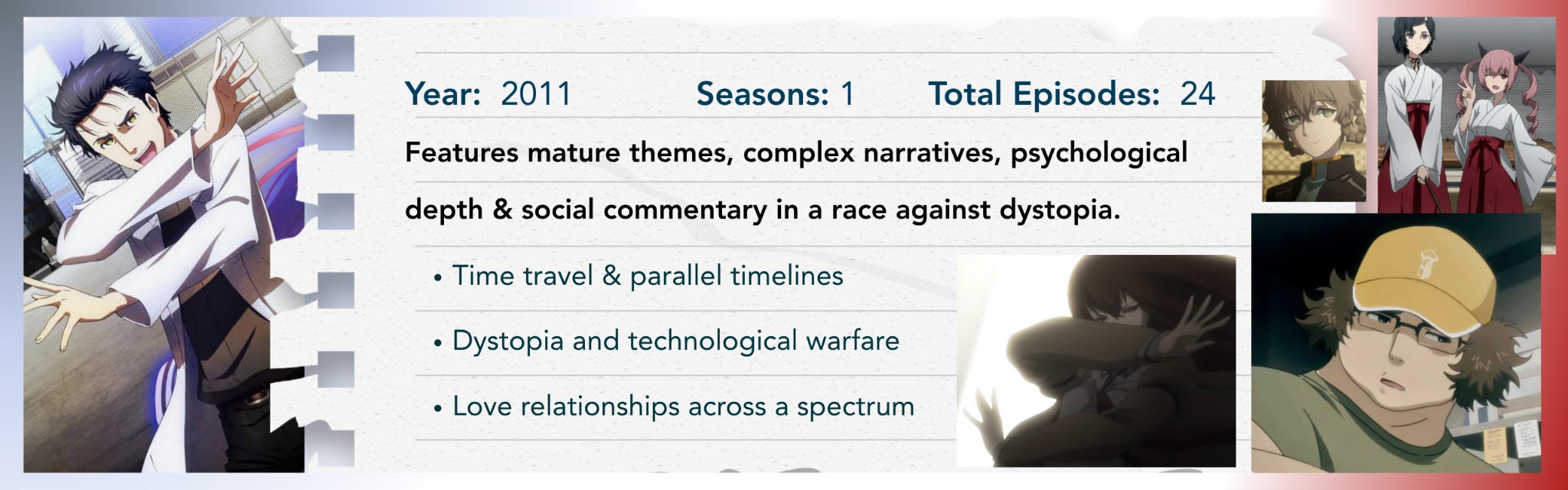
In contrast to the borderline surreal complexity of the storylines, Steins;Gate is realistically rendered with minimal expression effects, allowing the personalities of the characters and settings to trigger the chemistry between them. Awash with neutrals in the neighborhood of Akibahara, this science fiction classic could be visually exchanged for any typical slice of life anime. But it’s most visually reminiscent of the dark fantasy, Dororo, whose range of rich neutrals is punctuated by the vivid green of Dororo’s clothing, and the bright red bloodshed Hyakkmaru perpetuates in his quest for bodily restoration. In Steins;Gate, it’s Kurisu’s dark brick-red hair, and the soft blue of Mayuri’s dress and eyes that add a touch of vibrancy and keep the scenes from appearing flat, dull or repetitive.
The story pacing may feel difficult to measure until episode 8, as Okabe spends significant time spontaneously posturing as the fictional mad scientist, Hououin Kyouma, Daru wants every possible double-entendre repeated in real time, Mayuri mourns her cold karaage chicken and spoiled bananas, and Kurisu struggles to get her true name properly acknowledged. Viewers may wonder if the story will ever come together, until it does all at once, like particles in a high-velocity collider; at which point, it becomes heartbreakingly apparent how high the stakes really are for this group of people tinkering on the margins of scientific breakthrough and society. Unlike anime where the pacing is constant across the series, the tempo gets a serious uptick in the second half, as they race to a resolution that appears linear until it isn’t, much like Steins;Gate itself. But this lack of linearity does nothing to dilute the emotional impact of the latter portion of the series, as Okabe races to untangle World Lines through repeated sacrifice and courageous determination to restore peace, and avert both global and interpersonal disaster.
STEINS;GATE 0
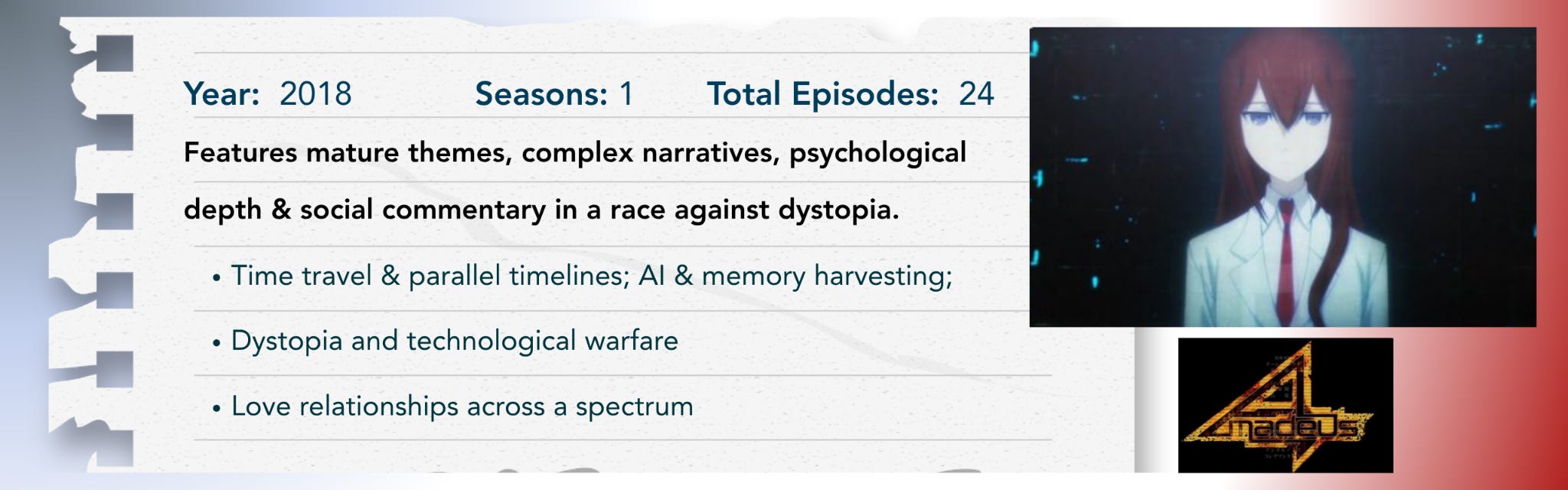
For those who loved Steins;Gate, its return seven years later may have flown under the radar due to the slightly revised title. True to form, the second “season” of Steins;Gate brings viewers into an alternate World Line where Okabe has chosen (or not chosen) a course of critical action with literal world-altering consequences, as well as the disappearance of his mad scientist persona, Hououin Kyouma. Through 24 additional episodes, Steins;Gate 0 folds in additional futuristic technology with an AI replication of Kurisu called Amadeus, and new adversaries hiding with plain sight through the capacity for advanced brainwashing across time.
The uneven pace set by the characters’ bantering in early Steins;Gate is gone, replaced with a more linear exploration of the intense emotional impact leftover when the trajectory of World Lines go wrong and a grim future has yet to be averted. If viewers have ever wondered what the story would be like if the initial ending resolution hadn’t happened, then Steins;Gate 0 will be a satisfying continuation. Like a reboot, Steins;Gate 0 resets the story back in time to deliver an alternate version of the same race against dystopia, fragmentation and loss, and pulls all the World Lines together again into a single coherent arc.
Similar to season one of Steins;Gate, the first half of Steins;Gate 0 is not predictive of the escalating emotional immersion that first begins to seep in halfway through, then gushes inexorably through the last handful of episodes. The bonds that connect the lab members, with an increasingly heavy emphasis on Okabe and Mayuri’s relationship, bear as much weight in the story as the complex timelines, technological leaps, and ominous global forces. But it is the re-emergence of Hououin Kyouma that marks the crescendo; and who, through his forceful charisma, exerts the actions needed to fight these destructive forces to the end.
TARGET AUDIENCE
The target audience for Steins;Gate likes complex and non-linear stories, science fiction that deals with time travel, physics and ad-hoc technology stacks, and stories about avoiding, resisting or overcoming dystopian events.
Fans would describe themselves as cerebral, romantic, STEM savvy, and idealistic. They believe in the power of living on the margins with a small circle of people who understand them, and in the idea that opposites attract. They appreciate the power of an inexplicable love for another person who is neither family nor a romantic interest, and that love does not require a utilitarian purpose or duration to justify its magnitude.
For viewers who prefer a single, linear story, or one where it is clear early on what the trajectory of the story arc is, Steins:Gate may feel confusing and unfathomable. The emotional payoff is slow to come, but intense when it lands, making it a perfect fit for patient viewers who are willing to delay gratification in exchange for a deeper meaning and experience.
OPENING, CLOSING & MUSIC
Steins;Gate has a solid opening with music by Kanako Itou, Hacking the Gate; however, viewers may find themselves wanting to jump right back into the story and choose to skip the opener especially once the plot starts coming together more coherently.
For Steins;Gate 0, the music reflects the deeper emotional undercurrents in both openings and closings, with opening songs Fatima and Amadeus by Kanako Itou, and the melancholic ending LAST GAME by Zwei, and the more fast-paced World-Line by Asami Imai.
But also not to be missed are the atmospheric instrumental pieces by Takeshi Abo, including Itsunohinika - Believe Me, Shuuyaku, and Chouyaku that amplify every scene they are in.
You can find complete soundtracks for Steins;Gate and Steins;Gate 0 on your favorite music streaming.
Ready to watch this anime? You can find it on Crunchyroll!
SIMILAR ANIMES
For viewers who are interested in the time loop dynamic, but also can’t resist a good isekai adventure, Re:Zero is the perfect match. With the MC protagonist able to “return by death” to a moment in the past after he dies, we see him willing to go back over and over to change the outcomes of the people around him with the same persistence as Okabe. Unclear who to trust or what everyone’s motives are, he also reflects the same undercurrent of uncertainty and low-level paranoia in Steins;Gate.
For viewers that loved the visual aesthetic of Steins;Gate, Dororo uses a similar palette set in a dark fantasy story in the age of samurai. Beyond just the visuals, the intensity of Hyakkkimaru’s platonic love in his relationship with Dororo matches Okabe’s with Mayuri, despite the difference in ages and broader plots. There is also a carryover with the actions of one impacting the lives of many, and questions around whether widespread disaster or dystopia can ever be averted by the sacrifice of one person.

For viewers that like stories grounded in time-looping, but want something a bit more titillating and less dystopic, Gnosia is drenched in vivid day-glo colors, sexualized characters, and lower stakes relationships. Based on a social deduction probability video game, Gnosia continuously loops through a range of characters on a spaceship trying to avoid being taken over by the Gnosia, humans infected with a homicidal virus. Like Steins;Gate, the fractured time-looping and character variability eventually pulls together into a unified story several episodes in.

And if you like the slow burn of a seemingly non-linear story where the ending episodes reveal the meaning behind what you have been watching all along, but don’t care for the time travel element, Shoshimin is a high school detective series with brilliant characters acting out their dark psychology to a surprise twist at the end.

SOURCE MATERIAL AND ANIME PRODUCTION
Wikipedia: Steins;Gate
ANIME
Steins;Gate is a Japanese anime television series produced by White Fox, based on 5pb. and Nitroplus‘s 2009 visual novel of the same name. The series aired for 24 episodes, from April to September 2011. The series was directed by Hiroshi Hamasaki and Takuya Satō, and written by Jukki Hanada, with character design and animation direction by Kyuuta Sakai, and music by Takeshi Abo.
The series has spawned one original video animation (OVA) episode, four original net animation (ONA) episodes, and a follow-up film. A sequel anime adaptation titled Steins;Gate 0, based on the 2015 visual novel of the same name, premiered in 2018.

The Window Seat Anime Journal publishes both spoiler-free “Snapshots”, and long essays for those who want to a deeper exploration of its themes. Make sure to subscribe and never miss a post!

I am reminded of it every time I go to Akihabara.
Steins:GATE is a touchstone of the anime world. It's one of those that nearly everyone's seen or at least heard of. In that, I'm actually a bit of an oddball. I liked it but it didn't hit me like it did most others. It's influence on the genre is undeniable though!