
DORORO
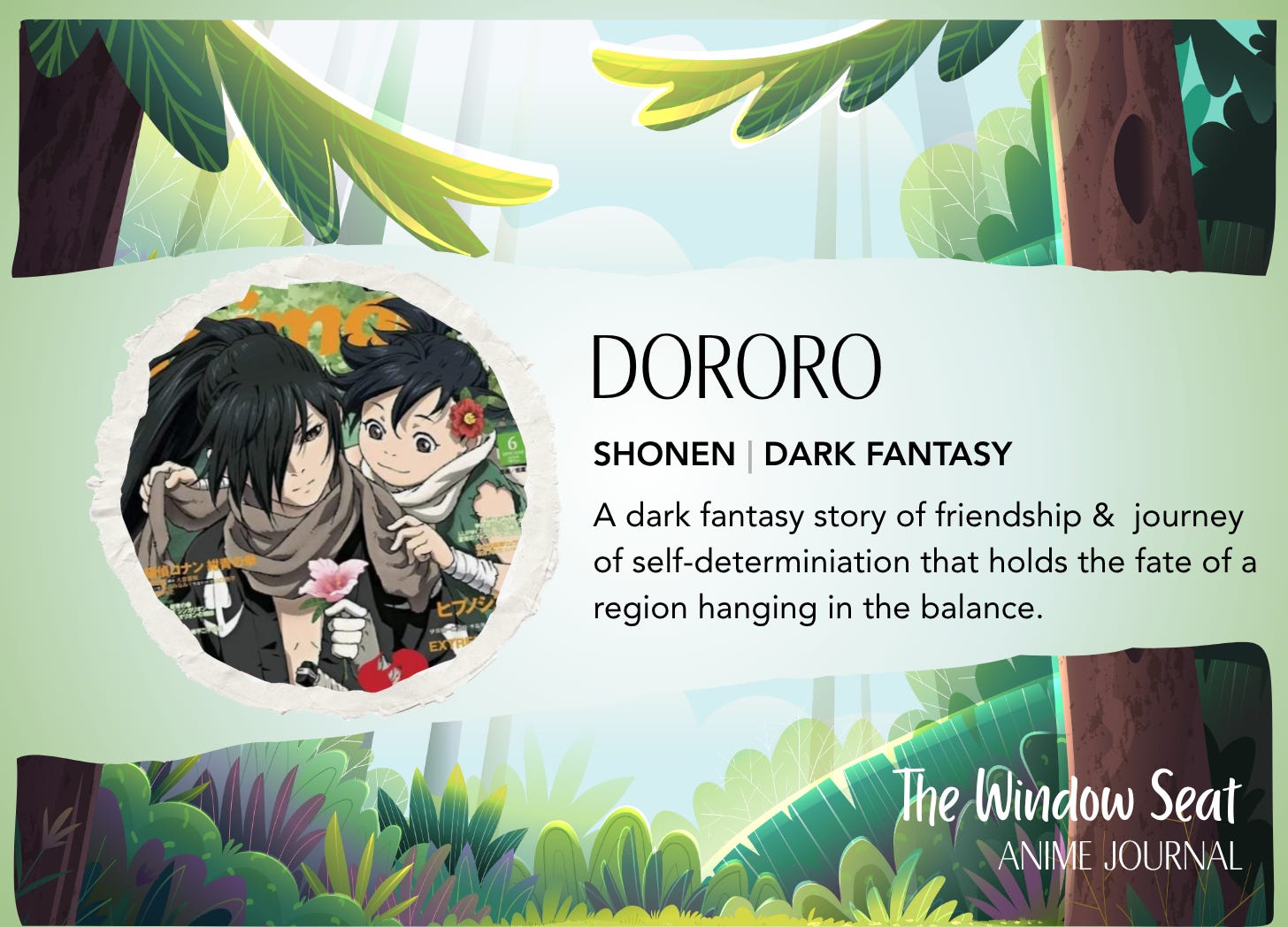
A dark fantasy story of friendship and journey of self-determination that holds the fate of a region hanging in the balance.
OVERVIEW
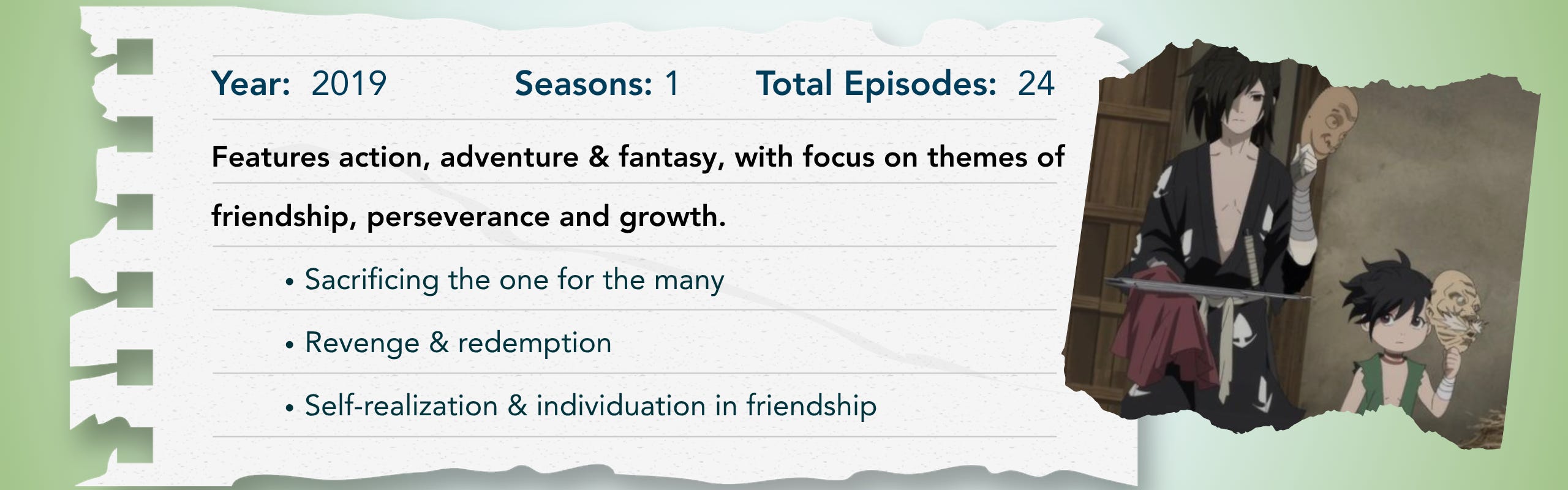
Dororo is a historical dark fantasy that follows the young pair of Hyakkimaru and Dororo, as they travel together to overcome the trials of their seemingly fated destinies. At their initial encounter, Hyakkimaru appears to Dororo to be a supernatural creature constructed entirely of prosthesis; but the truth is revealed that he lost his body in a demonic sacrifice at birth and seeks to reclaim the full spectrum of his humanity back from the demons, one corporeal piece at a time. Beginning with a simple alliance, their relationship deepens through their shared experiences on this journey and their own self-learning, fueled by Dororo’s unwavering loyalty and the gradual restoration of Hyakkimaru’s body and senses. Both characters strive to remain connected, as each overcomes the challenges from their familial legacies, while defeating other humans and demons alike in situations that threaten their survival and seek to undermine their right to live and prosper.
Special note: Viewers may hesitate to feel connected with the age gap between the main characters, but Dororo is the pinnacle of how to treat these kinds of relationships with respectful and endearing care. The precious bond of “chosen family” that arises between two young people who find each other serendipitously is what sets this anime apart from traditional buddy quests.
ANIMATION STYLE
Dororo is visually dynamic and expressive, masterfully combining highly choreographed and acrobatic action scenes with thoughtful portrayals of Hyakkimaru and Dororo’s interpersonal interactions. Depicting Hyakkimaru’s transformation into the increasingly living and feeling aspects of himself is a true highlight, especially when complemented with Dororo’s childish charm and charisma. The animation is detailed and richly illustrated in a neutral palette of predominantly black, browns and grays. This muted palette makes the green of the Dororo’s clothing and occasional foliage appear vibrant, and enhances the burning red hue of the demons’ souls and dramatic splashes of blood.
Dororo moves at a steady and progressive pace, with a strong balance between setting the thematic context of the story and moving the plot towards the conclusion of its dramatic arc. This balanced aspect is what makes Dororo appealing to such a wide range of viewers, as episodes contain both high levels of action and a focus on the relationship between Dororo and Hyakkimaru throughout his evolution. It also contains interconnected plot lines that encompass a range of implications for all of the characters involved, from the interpersonal journey of Dororo and Hyakkimaru, to the broader social and environmental conditions of the region.
TARGET AUDIENCE
The target audience for Dororo is teens to adults who want a thoughtful, serious story that has no fan service, and are willing to consider complex questions about personal sovereignty and social responsibility woven into an adventure quest. Fans of Dororo would be described as sensitive and emotionally aware, introspective, and interested in the intersection of societal, familial and interpersonal influences. They appreciate deep friendship stories, including those across age gaps, and stories where disability and/or disfigurement are overcome or transformed.
Fans of Ursula Le Guin’s, The Wizard of Earthsea, trilogy would find thematic similarities with Dororo, even though the plots are significantly different.
Ready to watch this anime?
You can find it on the HiDive channel through Amazon Prime!
SIMILAR ANIMES
For people who are interested in characters overcoming disability from their origin story, an unbreakable sibling bond and deep societal themes, Full Metal Alchemist: Brotherhood is the trifecta.
For people who like a more interpersonal journey of overcoming disability and regaining humanity, especially with a backdrop of war and violence, Violet Evergarden would be a match.
And for people who enjoyed the charm of Dororo and want to see a friendship story with a similar age gap but in a more realistic setting, Barakamon is a great choice.
REFLECTION QUESTIONS FOR DORORO
Do we accept Hyakkimaru as a “person” from the start? And if not, when do we decide that he is a person?
“Protectors” tend to be characterized by size and strength, but is this always true? How do Dororo and Hyakkimaru serve to protect each other on their journey together?
As Hyakkimaru recovers his body, does his motivation to stay with Dororo grow from fear of isolation or his desire for a family? and how would you describe their relationship?
We posted own thoughts on these questions, so be sure to read this long essay post after you watch the series:
SOURCE MATERIAL AND ANIME PRODUCTION
From Wikipedia: Dororo
MANGA
Dororo (どろろ) is a Japanese manga series written and illustrated by the manga artist Osamu Tezuka. Tezuka’s childhood memory of his friends pronouncing dorobō (どろぼう; “thief”) as dororo inspired the title of the series. Dororo was first serialized in Shogakukan‘s Weekly Shōnen Sunday between August 1967 and July 1968, before being cancelled. The manga was then concluded in Akita Shoten‘s Bōken’ō magazine in 1969.
ANIME
The first anime series, animated by Mushi Production, was broadcast on Fuji TV between April 6 and September 28, 1969, for 26 episodes. It was directed by Gisaburou Sugii, with music by Isao Tomita. Unlike the manga, the anime version has a conclusive ending. In 2008, Anime Sols began a crowd-funding project for official streaming of the show. Funding for the first half of the show reached its goal, and the funding continued for the second half. However, Anime Sols folded, and Discotek Media picked up the project and released it on DVD in 2016, including the show’s color pilot in the set.
A 24-episode second anime television series adaptation by MAPPA and Tezuka Productions was announced in March 2018. It was directed by Kazuhiro Furuhashi, with music by Yoshihiro Ike. The series aired for 24 episodes from January 7 to June 24, 2019, on Tokyo MX, BS11, and Jidaigeki Senmon Channel.

The Window Seat Anime Journal publishes both spoiler-free “Snapshots”, and long essays for those who want to a deeper exploration of its themes. Make sure to subscribe and never miss a post!
You can view our entire collection of writing on our Substack website at:
Dororo is very underrated anime. Very good choice for your first post. You have done very good job summarizing this anime from different directions (plot, animation style, target audience). I was shocked when I saw Barakamon in a similar anime. But that's very true, interactions between main characters are very similar.
My suggestions for future post: "Taisho Otome Fairy Tale", "Talentless Nana", "Mieruko-chan".