
WHEN ALL BECOMES ASH
The fragility of life, memory and identity in Grimgar: Ashes & Illusions
This post contains spoilers for plot and characters.
THE AMNESIAC HERO’S QUEST
A treacherous journey into unfamiliar territory to defeat an enemy is the hallmark of a hero’s quest; but in Grimgar, the existential disorientation stemming from the protagonists’ transmigration and loss of all memories, uniquely imbues this quest with additional layers of interpersonal exploration. Instead of a known and trusted team confidently embarking on their journey, Grimgar begins with a group of completely amnesiac strangers struggling on the outskirts of an unfamiliar town to both establish their individual identities, and decipher their new relationships as the first steps of the quest. Colored by their communal amnesia, this isekai anime sends its protagonists on an alternate version of the hero’s quest, one without a map, seasoned guide, or aspirational destiny beyond the need for immediate survival. Before they can move into their realigned future, they must first mark a new place on the blank slate of this unfamiliar terrain, with nothing but their intuition to help select a role around which to build their new identity.
Rather than initiating their quest with known predispositions intact, it is through the choice of their occupational guilds that each character’s identity is created anew. Despite the strangeness of the occupations available in this society, which appears far more primitive than what they think they remember, their actions are not entirely arbitrary. There is a residual constancy in their personalities that gives clues of who they are, and the types of roles that intrinsically suit them. Beyond these surface clues, their choices indicate deeply rooted attributes of themselves that remain intact even without memories, or understanding what this new world holds for them.
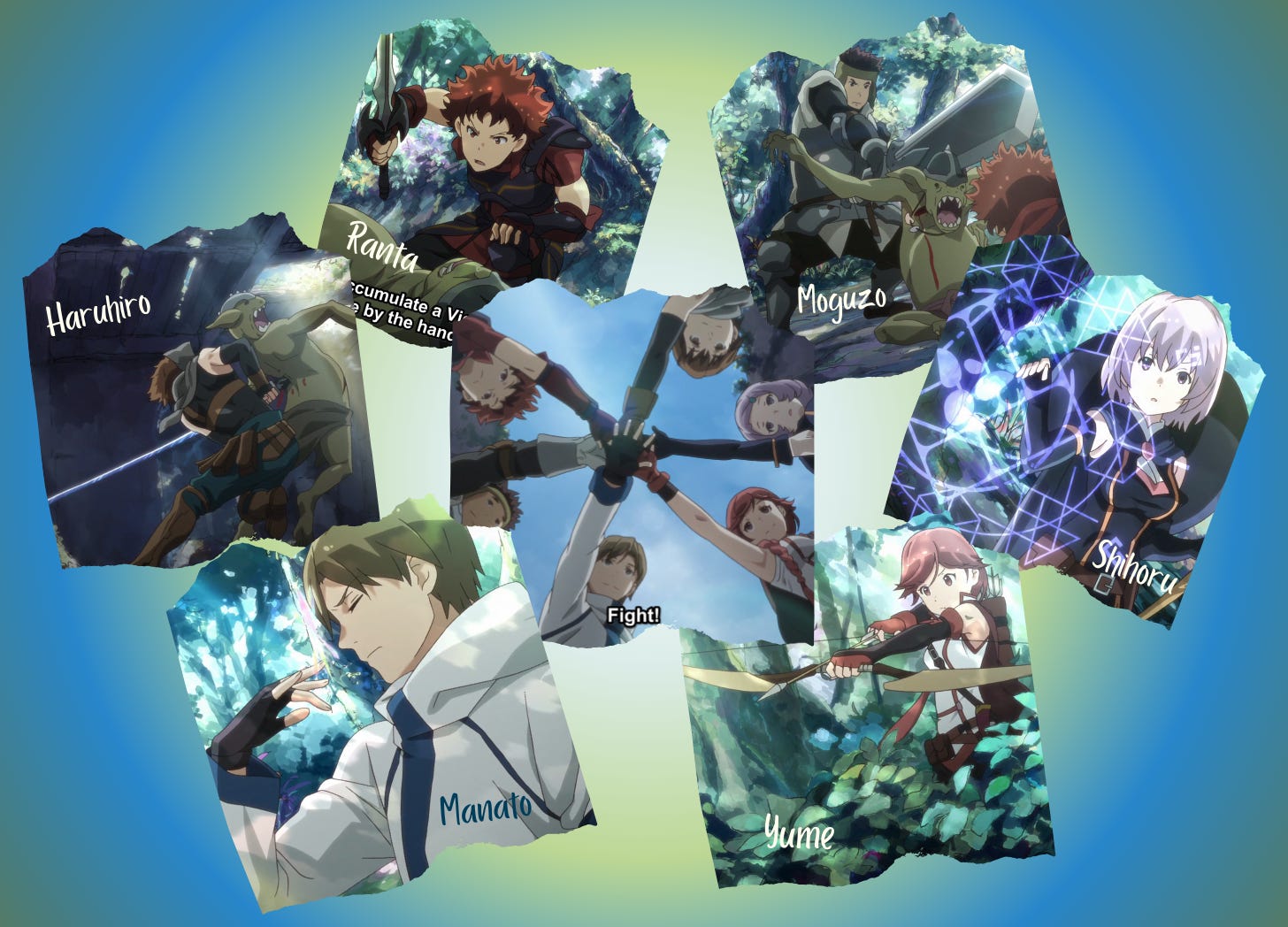
The band of protagonists, while randomly determined at the outset, has clear individuals: Haruhiro chooses to be a thief, a role that relies on “sneak” attacks or approaching “under the radar”, fitting to his non-confrontational leadership style. The vulgar Ranta is unsurprisingly attracted to the Dark Knight, while the thoughtful Manato gravitates towards the protective and healing role of the Priest. Gentle giant, Moguzo, wields the largest weapon to match his size, and pairs it with the same word he uses when offering food. The two girls also find roles that suit their nature, with the shy Shihoru becoming a Mage who can fight from the margins; and the versatile Yume opting for the Hunter, giving her access to different fighting modalities from archery to hand-to-hand combat.
Even as they struggle to master the skills of their selected guild, their role choice indicates that each member holds innate knowledge about themselves that is incorruptible. Beyond this initial determination of the guild that will enable them to contribute to their overall survival, each person bears responsibility to exert the ongoing concerted effort required in this space of existential uncertainty. By the consistency of their individual actions and willingness to invest in the team as a whole, these roles begin to solidify their new identities and set the course for future events.
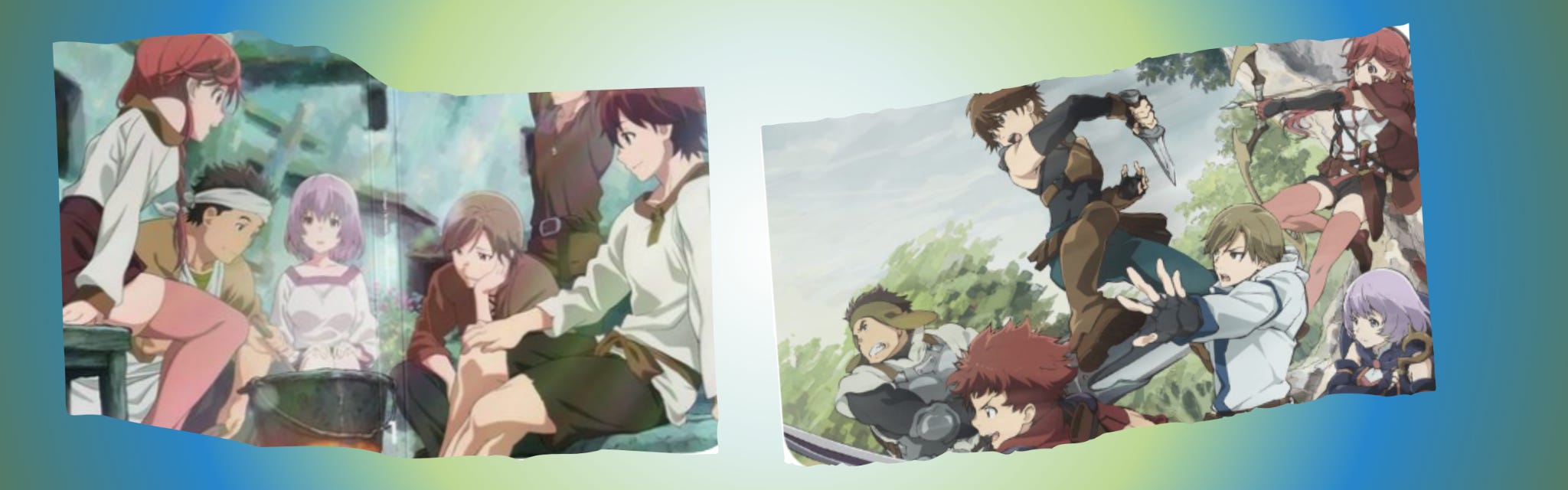
No matter how loyal to one’s deeper self, an individual choice towards identity remains insufficient to build the genuine camaraderie that will determine a team’s success throughout a journey’s obstacles. For the group to cohesively persevere, there must be a sense of belonging not only to oneself, but also to their communal interests and shared goals. It is this lost sense of inherent belonging, along with memory and identity, that marks the third aspect of a typical hero’s quest that is absent here in Grimgar. The protagonists are joined together, not by mutual understanding or past experience, but for the sole reason of not being selected by any other team at the outset. In this fractured reality, the protagonists are left to perform their small heroic acts as misfits that no one else wanted to work with, in order to mend their sense of selves, establish new relationships, and uncover the meaning of their shared fate.
PARALLEL TRAJECTORIES AS A MIRROR OF ILLUSION
Grimgar further dismantles the singular forward progression of a hero’s quest by duplicating the protagonists’ shared experiences through the parallel storylines of Manato’s death and Mary’s survival. Rather than a character’s originating features serving as the catalysts for emotional evolution, (e.g., being orphaned, having hidden talents, or magical powers), Grimgar instead has the protagonists confront an alternate version of their own loss, a mirror reflecting back the same shock and paralyzing grief, as the driver for their deeper introspection. As the protagonists face how they all contributed to Manato’s death by allowing him to carry so much responsibility, so too Mary must face the death of her entire team due to her own exhaustion as their Priest and healer for the same reason. As a result, each individual struggles internally with survivor’s guilt, creating a grim, shared responsibility that threatens to undermine their cohesion as a team.
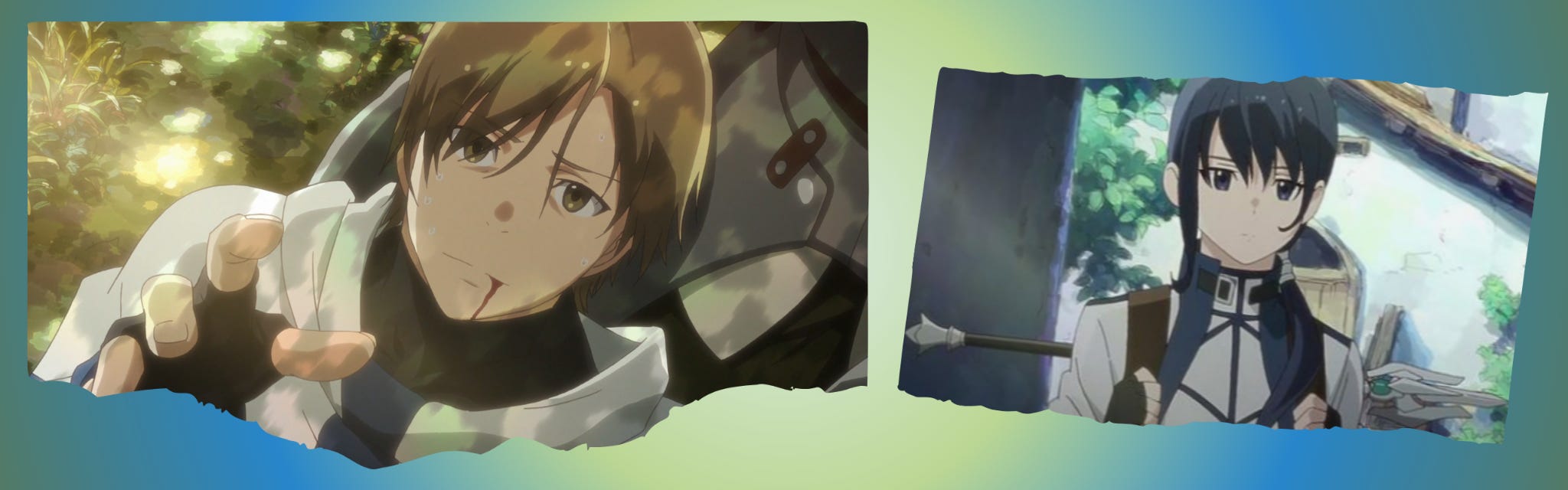
Through these parallel stories, they recognize that people are undergoing tragedies similar to their own, even in the isolated slice of the world they inhabit. It becomes an integral thread of their shared fate to vicariously relive the same experience through another’s eyes. Through this reflection, new perspectives arise from the force of empathy and contemplation of its alternate outcome; and they broaden their capacity to welcome another person into their group who feels a similar sense of having no place in which they belong. Their shared experience of grief and forced maturation as a team now binds them: a linkage far stronger than the randomness that drove their initial connections, because now they consciously choose each other as partners for their quest.
PURIFICATION BY ASH
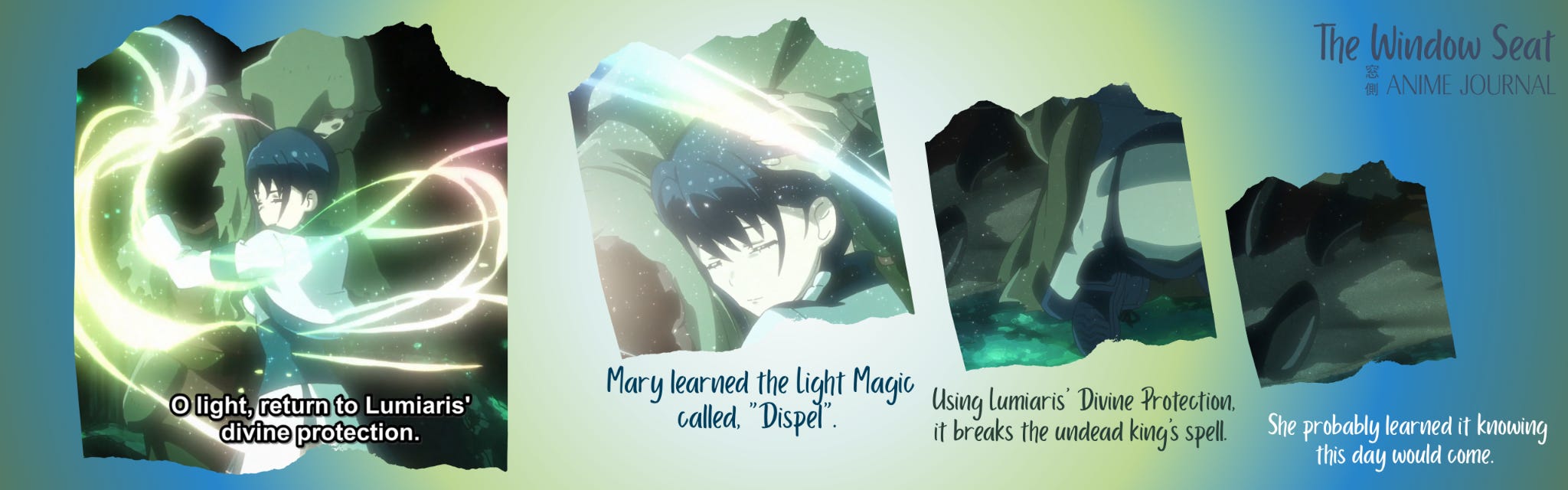
As the team moves into the Cyrene mine to fight the fearsome Kobolds (the monsters who previously killed Mary’s entire team), their introspective journey further deepens into these parallel storylines with the dissolution of Mary’s undead teammates into ash. Because a corpse will rise as the undead unless it is cremated, the Dispel magic that renders them to ash provides the first step towards the closure that had occurred previously with Manato’s cremation. Throughout the arc of Grimgar, this process of dissolution to both physical and metaphorical ash (of corporeality, of naivete, of self-ignorance), facilitates the team’s ongoing growth of self-awareness, as their illusions about themselves increasingly fall away.
Kobolds are not the enemy. Our own weak selves are the enemy. ~Haruhiro, Ep. 11
As Mary embraces the ash of her friends in their release, the underlying psychic implications of Manato’s cremation rise to the surface with the upwelling tripartite symbolism tied to ash throughout their journey:
To experience one’s memories and identity turned to ash by amnesia.
To feel one’s emotional landscape turned to ash by grief and shame.
To find closure by turning the body of a lost friend to ash.
Ash emerges as a merciless alchemical exchange involving the loss of beloved living people for increased visibility of one’s own inner landscapes: they cannot confront illusions about themselves until Manato’s death and cremation, and they cannot perceive the illusory fragility of their bonds to each other until the undead are turned to ash by Mary’s Dispel magic.
ILLUSION & ASH AS THE ENGINE OF THE QUEST
It is this alchemical exchange, of the certain, known, and corporeal for the illusory, amnesiac, and ashen, that drives the evolution of Grimgar and its characters. They are forced to consider what touchstones in their lives give them a sense of permanence about themselves, and what does it mean when those anchoring ideas, memories, and identities are reduced to ash in their new world’s journey. Absent any illusions about themselves from their past lives, they rely on instinct to choose a guild to guide them in a new direction. Even as they put forth their best efforts to rebuild themselves, the cycle restarts with the traumatic loss of their team’s spiritual heart and healing presence.
In turning the bodies of their Priest and Mary’s team to ash, they move beyond the boundaries their amnesia to confront and dispel their deeper self-illusions . Through loss and cremation, they enter a cyclical process where an illusion is turned to ash, and the dissolution to ashes helps them better see what other illusions may be blinding them.
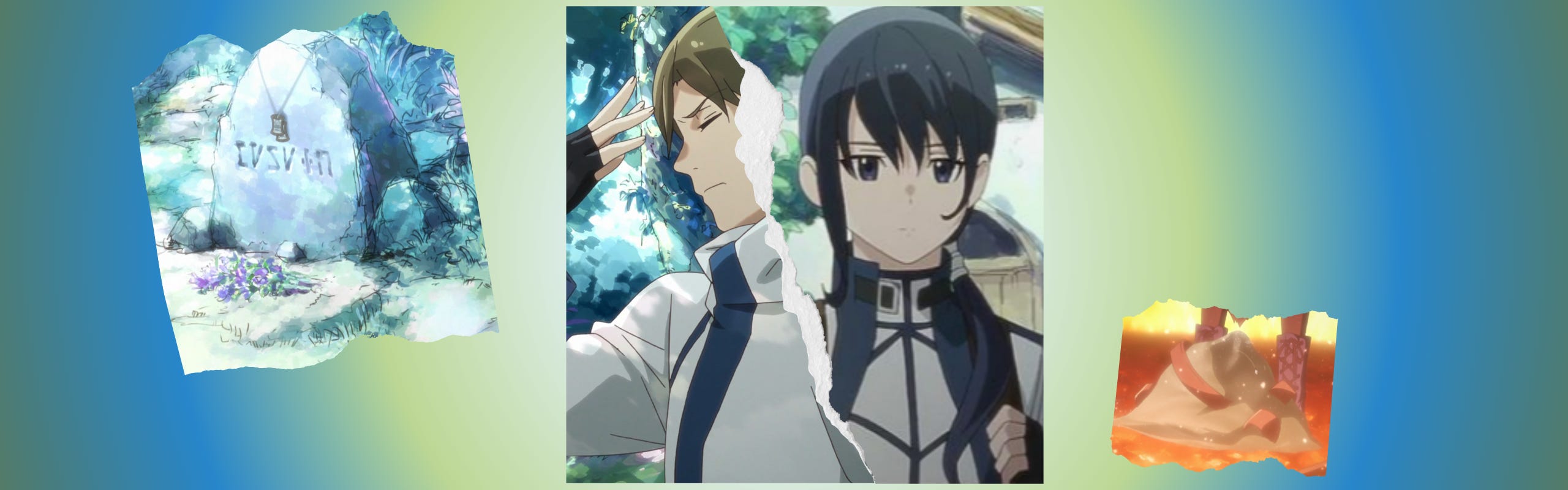
This ash of their fallen teammates triggers an awareness of their inner potentiality that had been buried by the disorientation upon arriving in this new world. We witness the culmination of this potentiality at the end, particularly in Haruhiro, as his latent talents emerge under duress, and enable him to kill the formidable Death Spots, in the Cyrene Mine. Even though he is temporarily separated from the others, they as a team are able to regroup under Ranta’s spontaneous leadership, and all escape the mine intact. As this victory marks the resolution of their parallel stories, their questions of identity, and their struggle to belong, final closure is brought to Manato’s grave, adorned with its own Volunteer Soldier’s badge; and they give a final farewell to the past to unbolt the gate of their renewed future.

Leave a comment and let us know what you think! And feel free to share other anime that are similar or that you would like us to write about at The Window Seat Anime Journal. Thanks for reading (or listening)!
Did you enjoy reading a long essay? You can find other long essays at our Substack website, including this piece from the dark fantasy, Dororo:

Or the high school mystery series you are sure never to forget, Shoshimin:

The Window Seat Anime Journal publishes both spoiler-free “Snapshots”, and long essays for those who want to a deeper exploration of its themes. Make sure to subscribe and never miss a post!
You can view our entire collection of writing on our Substack website at:
Ohhh your section on ash opened our eyes! It was always in the title, but we never considered how it might be so explicitly tied to a theme in Grimgar 😃 thanks for the read! 💙
Interesting that death and destruction are so common in this world.