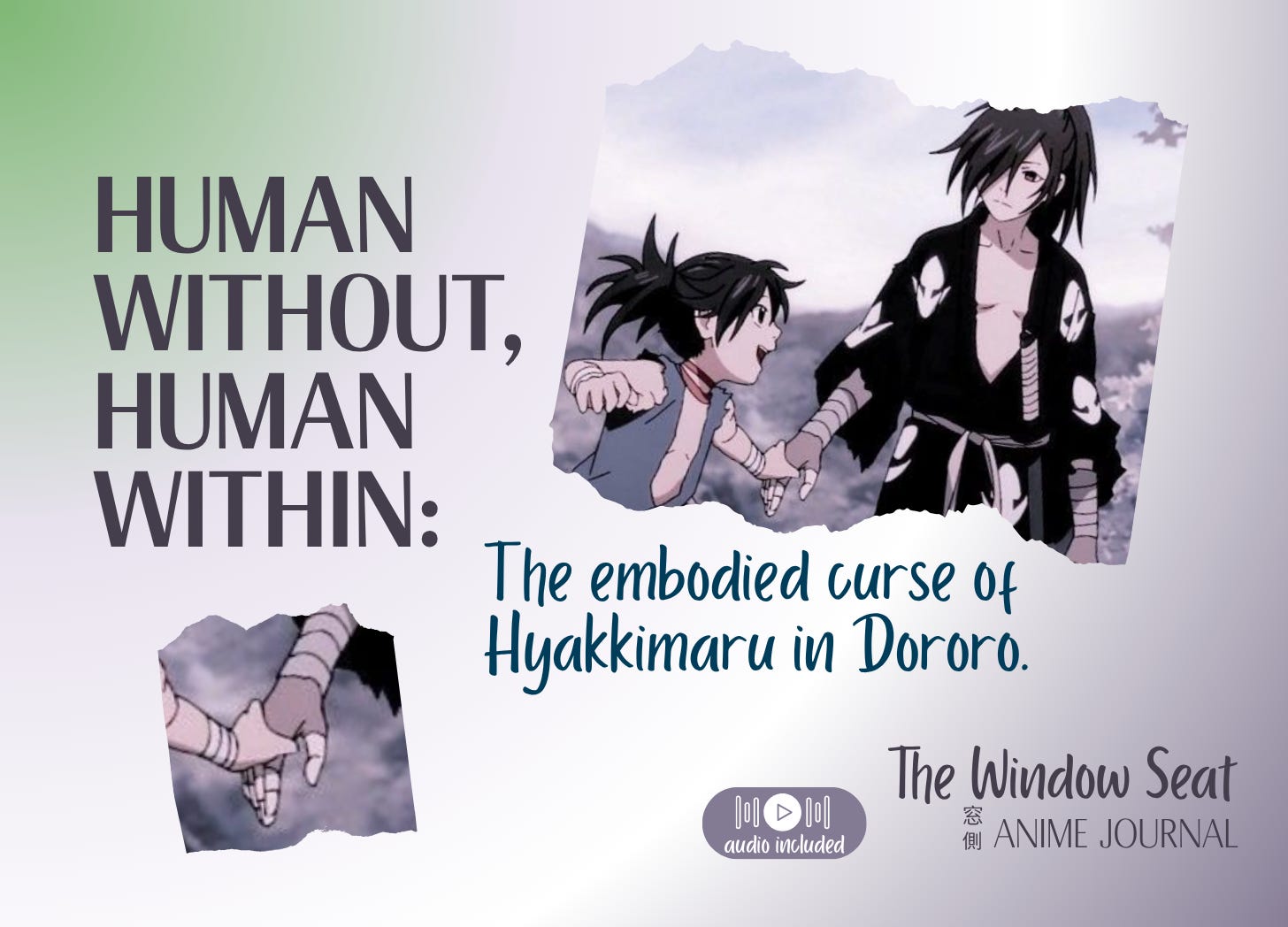
HUMAN WITHOUT, HUMAN WITHIN
The embodied curse of Hyakkimaru in Dororo
This post contains spoilers for plot and characters.
Human? What is human? I am a curse on this land. ~Hyakkimaru (Ep. 23)
With this declaration, Hyakkimaru echoes the early words of the blind, itinerant priest, Biwamaru, who foreshadows this critical underpinning in Hyakkimaru’s quest toward a fulfilled humanity. Found in a rowboat stripped by demons of his limbs, all sensory abilities, and his skin at the moment of his birth, Hyakkimaru exists in the penumbral margins between human and creature, adrift on a river towards a fated but unformed destiny:
Not a human, not a ghoul either. I sense a curse. ~Biwamaru (Ep. 1)
This initial perception by Biwamaru sets the stage for our own interpretation of Hyakkimaru, as we witness him interacting with a close circle of other characters who seek to define him, including the young Dororo and Hyakkimaru’s own estranged family. Throughout this series, Hyakkimaru is rarely referred to as a human or as a person by many of those closest to him, even as he regains his sensory abilities, establishes a loyal and caring relationship with Dororo, and strives to articulate his innate desires to be fully manifested into the corporeal entirety that was robbed from him at birth.
THE QUESTION OF HUMANITY
As we seek to establish our own interpretation of Hyakkimaru’s humanity, we are forced to contemplate the constructs of what it means to be human. Many works of science fiction have asked these questions of what defines a human versus a non-human, often in regards to clones, androids, and cyborgs. While Hyakkimaru differs from these machine-based examples based on his birth origin, his dramatic physical alteration and the curse’s influence are so intractable, that we are compelled to wonder if his humanity is retained within the fragile shell of his dark and silent existence.
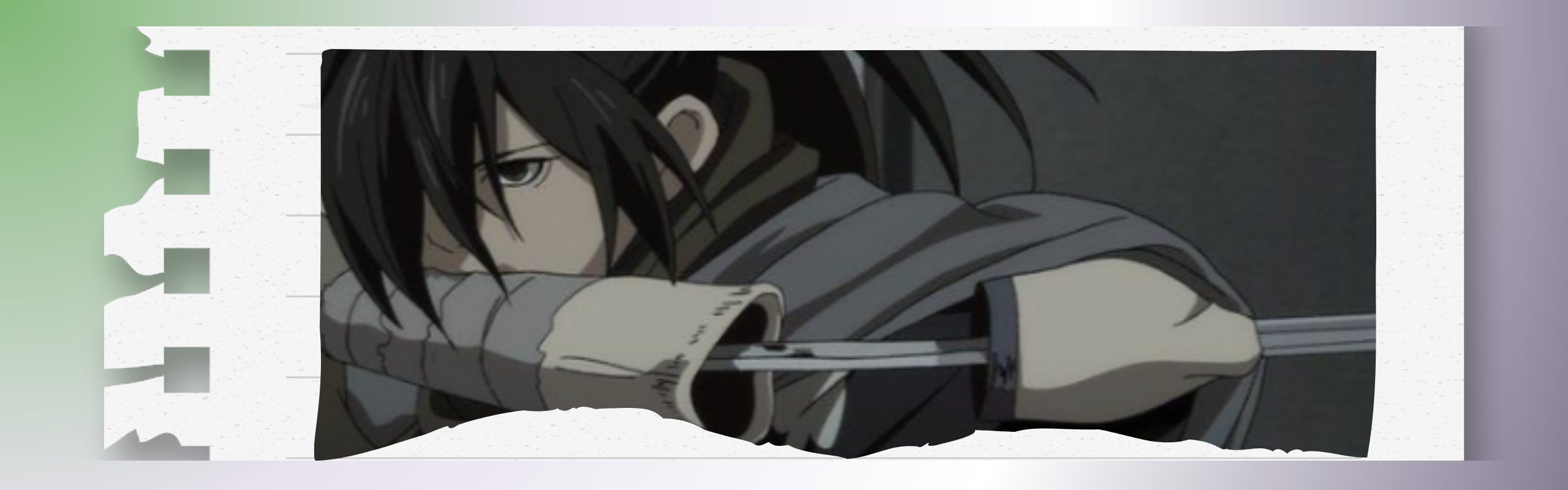
In particular, we believe that the experience of reality itself is vastly different for Hyakkimaru compared to our own, and subsequently assume that his capacity for human relations is compromised. In the early story arc, absent any sense of his childhood development, we can’t break away from the limiting perceptions of the other characters. With his prosthetic limbs and fully masked face, bandits refer to Hyakkimaru as “like a doll”, while Dororo openly questions if Hyakkimaru is human. We are primed to question his humanity from the start, even as we grapple with the moral question of whether it rests solely on Hyakkimaru’s shoulders to prove his humanity to everyone – including us. As we are challenged by our formative belief that Hyakkimaru’s humanity was lost alongside his extreme disfigurement, this poses a more frightening existential question: is our humanity that easy to denigrate with the loss of limb, sensory perception, and cognitive ambiguity?
Across the series arc, we must accept the responsibility to bear our own witness to Hyakkimaru’s experiences, and are prodded to make our own interpretations; however, we also rely on the observations of Biwamaru to provide us with the most candid descriptions of Hyakkimaru’s struggle to retain and express his humanity. His language often pigeon holes Hyakkimaru into his limitations, but also strips from us a delusional optimism that would reject his demonized attributes in favor of only focusing on purely external triggers for his actions. The priest’s ability to see a human being’s energy keeps us aware of the curse’s remnants in Hyakkimaru:
Demon flames…embers left from when they took his body. ~Biwamaru (Ep. 6)
When Hyakkimaru struggles to integrate his new sensory inputs, Biwamaru again paints an animalistic metaphor of Hyakkimaru’s early experience:
Like a wounded beast in a cave. ~Biwarmaru (Ep. 6)
He describes Hyakkimaru’s quest for his body as comparable to a baby trying to recover a toy that was taken from him. At its most extreme, he predicts the outcome of Hyakkimaru’s eventual emergence from his life’s history of sensory withdrawal with an ominous prediction:
You better hope the beast that comes out of the cave isn’t a monster. ~Biwamaru (Ep. 6)
SENSORY AWAKENING & THE BOND WITH DORORO
The constant, pressing, thematic inquiry throughout the series is what Hyakkimaru is conscious of – in himself and others – to give us an idea of how he is interpreting his environment, and to what extent he feels, both tactically or emotionally. With these perceptual concerns, we subconsciously set a limit on how much they can be altered before we see Hyakkimaru as a non-human, demi-human or a cursed human; or simply as a young man on a quest against insurmountable odds, deserving of our sympathy.
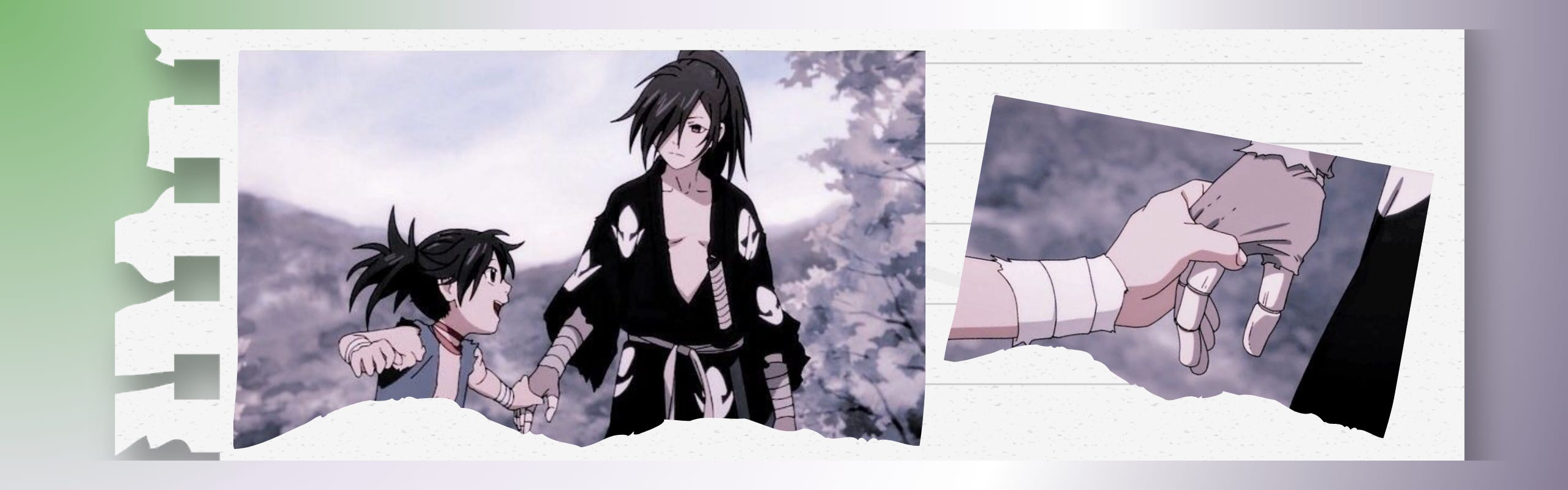
His capacity for feeling becomes the heart of the question, and it is Dororo who offers us the purest channel for Hyakkimaru’s emergence of feeling into the world. Because she never questions his ability to feel, she enables his embodied transition into an increasingly sensory being, and she becomes the medium to reflect Hyakkimaru’s capacity to feel to those around him. From breaking her enchainment with a cursed sword, finding care for her when she is sick, and rescuing her when she is kidnapped, Hyakkimaru’s quest to be whole becomes inextricably tied to Dororo’s descriptions of the world and its vibrancy, strengthening his desire to have sensory parity with her in life experiences.
But it is Hyakkimaru himself who poignantly reminds us through his words to his foster father, that he has always felt, even before he could perceive touch and pain. With that simple statement, delivered even before his arms and eyes are restored, we question every previous moment when we doubted his human capacity, and his undeniable human suffering.
THE HUMAN / DEMON TRADE FOR POWER
Hyakkimaru’s evolution encompasses more than just his increased emotional bond with Dororo, as witnessed by his use of strategic reasoning to overcome his sight disability within a giant celestial centipede’s demonic cloud. It would be uncharitable (and incorrect) to describe Hyakkimaru as “developing” cognitively, as opposed to finding himself with greater tools at his disposal, such as his voice and hearing.
This seemingly linear evolution is disrupted by the revelation of the disastrous impacts Hyakkimaru’s physical restoration is having on Lord Daigo’s kingdom, reminding us of the criticality of the human / demon trade for power underlying the fabric of this story. Hyakkimaru’s story is not the only barter between humans and demons for power in this series: their journey involves other instances where humans are fed to demons to retain the prosperity of a town or region, with most of the sacrificed humans considered as “outsiders”, and therefore expendable. When Hyakkimaru is successful at intervening in a story that more closely mirrors his own – the feeding of a bride sacrifice to a demon to reduce its threatening presence – he ironically frees the region of its repetitive catastrophe by eliminating rather than appeasing the demonic forces at the roots of their instability.
In contrast, the drought and war on Lord Daigo’s territory sets the stage for the devastating reunion between Hyakkimaru and his family in the mid-point of the series. As each family member reveals their own fatal interpretation of his dehumanized fate, he is cruelly exposed to their enmity directly toward his living presence for the first time:
Lord Daigo’s contempt: half-born demon child
Tahomaru’s betrayal: you are a demon to us
Lady Nui’s capitulation: I cannot save you
Through these declarations, Hyakkimaru is confronted by the cruelest truth: he is neither viewed as human by his own family, nor as a person worthy of his own life and destiny; to his family, he is but a pawn for the land’s prosperity itself. Dororo mirrors our own despair and incredulity at this abject rejection of Hyakkimaru as even human, much less as part of their family. And at this juncture, we witness a critical reassessment of Hyakkimaru’s humanity, autonomy, and entitlement in this world.
Spurned by his family, Hyakkimaru redoubles the intensity of his efforts for restoration and the demons that feed upon humans for their own ends. However, the ethical lines around his choice of actions become blurry when a village burns down as a result of their intervention in its own demonic transaction. Despite the victory of Hyakkimaru recovering his vertebral spine through this encounter, Dororo expresses her dismay at their role in this village’s destruction. While she vehemently protested the family’s utilitarian view of Hyakkimaru as a currency of exchange with the demons for their own prosperity, she becomes more uncertain as she witnesses first hand the broader devastation that follows Hyakkimaru’s pursuit of his fully restored bodily form. Hyakkimaru dismisses it unequivocally as “not his concern,” and surfaces the heretofore unspoken questions regarding the legitimacy of his humanity and its sacrifice.
HYAKKIMARU AND NIHILISM
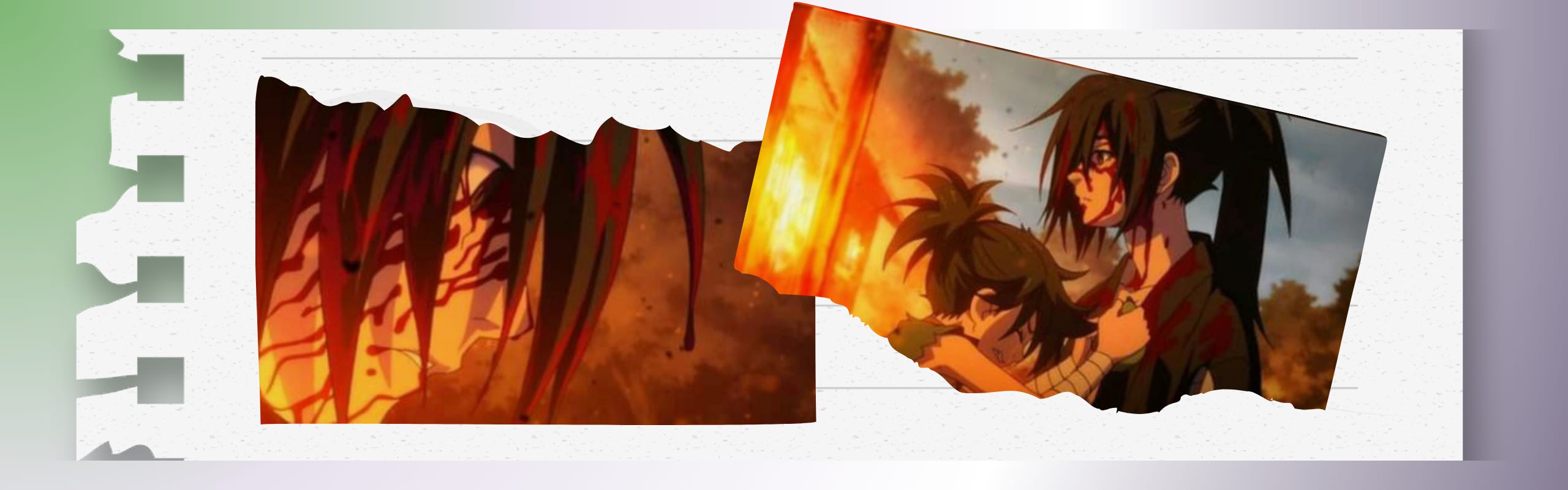
I won’t lose to a demon’s leftovers. ~Lord Daigo (Ep. 23)
It is the shift from self-actualization to vengeance by which Hyakkimaru becomes increasingly human in physical form, but risks becoming increasingly demonic in his actions to fulfill his desire for complete corporeality. We see the brutality of his revenge when he cuts down numerous samurai after the murder of Mio for being a suspected spy, and thus crosses the line into the killing of humans. And we see this same murderous intent take over Hyakkimaru’s psyche when anyone threatens to separate him from Dororo.
Dororo validates our fears that Hyakkimaru becomes someone other than himself as he pursues both his remaining body and bitter revenge against Lord Daigo. As his destiny unfolds in the beginning, his killing of demons is swift and uncomplicated, and helps both himself and the people in villages plagued by these demons; a positive, cumulative effect that comes along with the return of his body parts. But when Hyakkimaru becomes singularly intent on recovering his body, even knowing it could negatively affect the land and its inhabitants, his actions border on the nihilistic and incorporate a new level of brutality. Hyakkimaru disregards other humans, the fate of the land, and even Dororo’s heartfelt entreaties in his quest to rectify the demonic bargain Lord Daigo made upon Hyakkimaru’s birth to fulfill his narcissistic ambitions. In parallel, both Lord Daigo and Hyakkimaru reveal the difficulty in claiming virtuous intent, when a fully selfish desire is at its origin. As his quest for his body supersedes all his other accomplishments, the potential for empathy to drive his evolution diminishes, leaving a darker space for the demonic embers to increase in power.
It is during his separation from Dororo and his reunion with his foster father, Jukai, that this reckoning of his humanity is confronted directly from an adult more versed in the consequences of life choices involving extensive killing. Upon hearing of the trials of his life, Jukai inquires,
You look more human than you ever have before. But are you not less human on the inside? ~Jukai (Ep. 17)
He also confronts the sacrifice of other humans in Hyakkimaru’s destiny:
Will you still be human then? All that’s left beside you will be lifeless corpses. You will be alone in this world…If there is someone in your life that is not your enemy, that person might be able to keep you human. ~Jukai (Ep. 17)
Yet, even as Hyakkimaru acts from his deepest love when rescuing Dororo on the cape where she has gone to seek her father’s treasure, his humanity is still not apparent to those around him who have long bargained with demons for power, as the one-armed fisherman, Shiranui, goads his demon shark to feast on him:
That broken excuse for a human is no match for you. ~Shiranui (Ep. 18)
After Dororo almost drowns when her arm is trapped in a rock fall and he fails to find a way to free her, his despair and frustration at his body’s limitations once again incite his savagery, which he unleashes when killing a multi-animal demon that fails to return any part of his body to him. While Dororo is shocked by his viciousness as he stabs the demon beyond the point of inevitable fatality, the creature marvels at his strength and prowess:
That’s why…you aren’t really human, are you? ~Nue (Ep. 20)
HYAKKIMARU AND MERCY
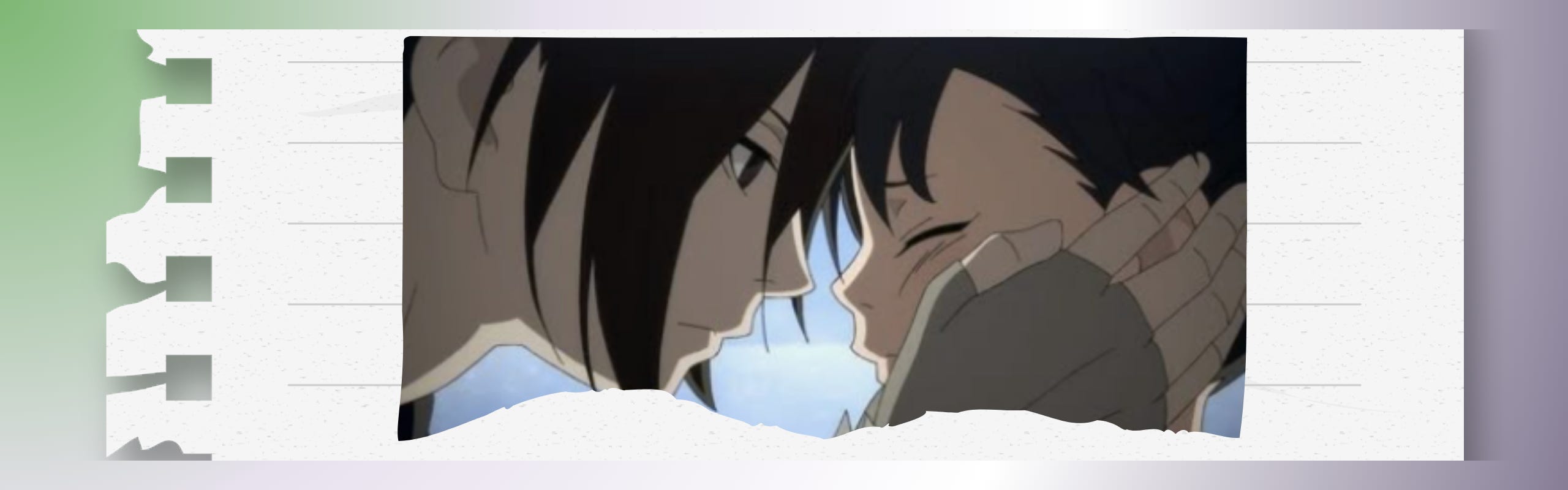
Woven throughout the story of Hyakkimaru’s destiny is the presence of the Buddha and the underlying ethos of compassion and mercy. At the moment of his nascent disfigurement, the Buddha statue belonging to Hyakkimaru’s mother loses its head, its own sacrifice to take the place of his in the moment when his entire life would otherwise be extinguished. In a strange twist, as though even this heavenly sacrifice had only a fragile permanence, Hyakkimaru nearly loses his face to a stone carver who seeks to placate a Buddha possessed by a demon. But upon her own imminent death, the carver acknowledges that it is Dororo who possesses the face of the Buddha, the outward manifestation of the energetic visage that Hyakkimaru has felt all along. And despite all his own actions of moral question, through vengeance, violence and despair, his gravitation towards her as his north star of existence enables a recurring recovery of his human spirit throughout his darkest moments and deeds.
As such, Dororo holds the true key to Hyakkimaru’s transformation: Dororo recognizes that the purity of one’s heart is the opposing strength that defends the good. Amidst all those who deny Hyakkimaru’s humanity, she emanates a wholly compassionate and unselfish presence towards him, supporting his desires and struggles to regenerate his stolen existence. Her loyalty, while unwavering, is never blind: she confronts his darkness with her own unique radiance of heart. The constancy with which she always acknowledges his human worth is what enables him to pursue his destiny beyond closing the bitter circle with Lord Daigo and his family. As his foster father and birth mother surrender to their role in the reckoning of Hyakkimaru’s destiny, he is once again gifted with the Buddha; and is finally equipped, beyond the limbs and sensory perception he’s acquired, with the unequivocal reflection of his humanity in their eyes.

Leave a comment and let us know what you think! And feel free to share other anime that are similar or that you would like us to write about at The Window Seat Anime Journal. Thanks for reading (or listening)!
The Window Seat Anime Journal was created to provide a “book club” experience for anime content by introducing people to new anime and providing a forum for the deeper thematic exploration that all great anime truly deserve.
Make sure to subscribe and never miss a post!
Did you enjoy reading a long essay? You can find other long essays at our Substack website, including this piece from the gentle isekai, Grimgar, Ashes and Illusions:

Or the high school mystery series you are sure never to forget, Shoshimin:

The Window Seat Anime Journal publishes both spoiler-free “Snapshots”, and long essays for those who want to a deeper exploration of its themes. Make sure to subscribe and never miss a post!
You can view our entire collection of writing on our Substack website at: