

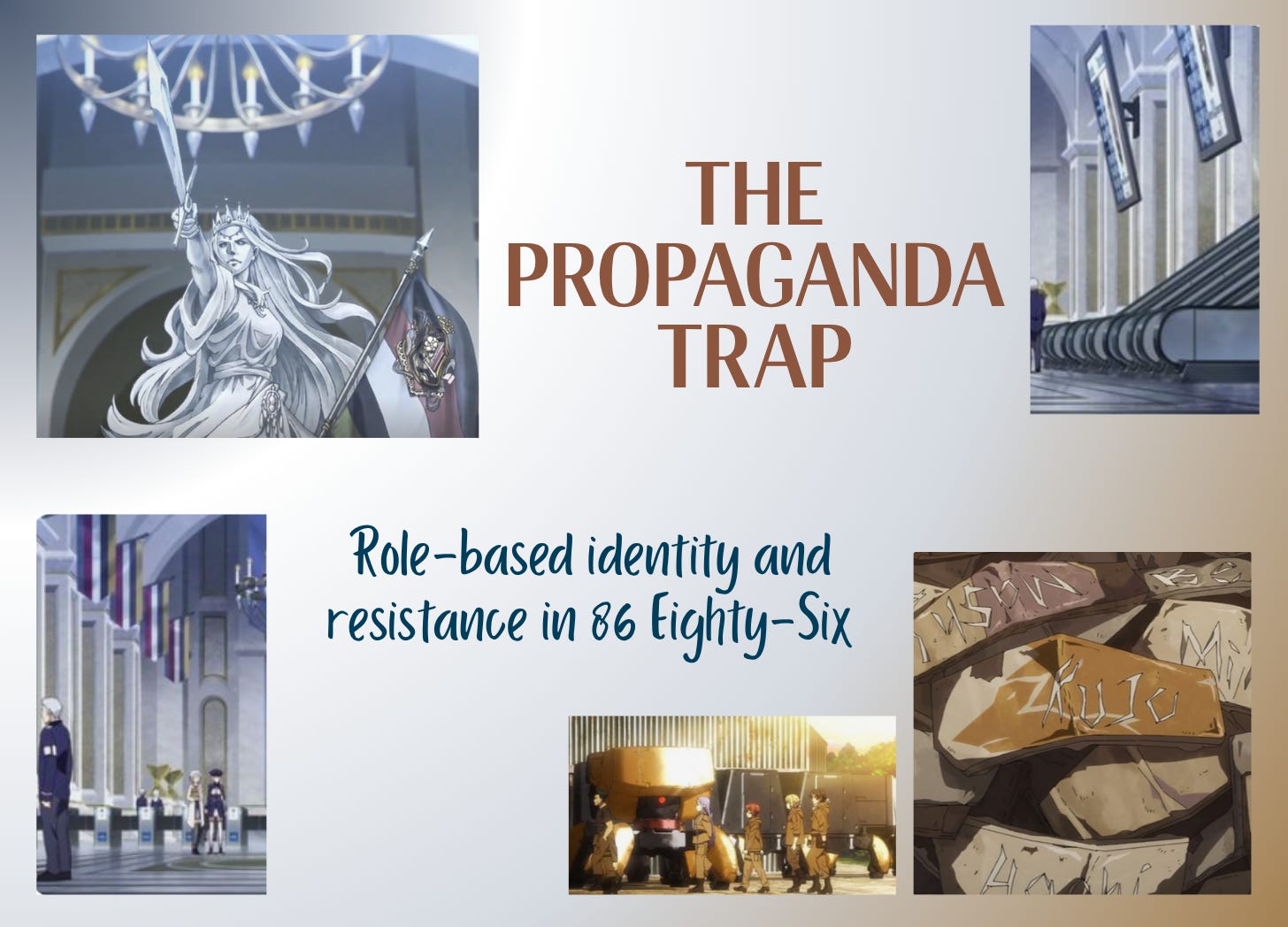
THE PROPAGANDA TRAP
Role-based identity and resistance in 86 Eighty-Six
This post contains spoilers for plot and characters.
Set within a dystopic future, 86 Eighty-Six is an anime continuously asking viewers if they are seeing the whole truth. The foundation of its story arc appears to be a linear trajectory: the fully automated troops of the Legion are advancing on the Republic of San Magnolia, and San Magnolia is responding in kind with its own mechanized infantry. But this simplified narrative, with a clear enemy and proportionate response, is just a construct of San Magnolia itself. The truth is hidden in propaganda that obfuscates, denies, and reduces the complex human impacts into soundbites filled with misdirection.
Presented in slices from different perspectives, 86 Eighty-six is filled with opposing viewpoints about what is happening in both the Capital of the “elite” society, and outside the Gran Mur walls on the battlefield with the Legion. It is masterful in the way it drops the viewer into a world of questions, polarities and contradictions, particularly around the roles of its characters and their meaning, justification and limitations.
To maintain balance in its viewpoints, 86 Eighty-Six swings back and forth within the confines of its story arc in an alternating dance of tight control and unleashed inhibition. The viewer feels the constrained politics of San Magnolia contrasted with the rigid frames of the Juggernauts, further emphasized by the loose-lipped, drunken Magnolia officers’ slurs and the sarcastic Eighty-Six exchanges during downtime at their barracks. By always showing viewers an alternating vantage point, viewers are forced to question the narrow lens they are given and what influences make it so focused in that particular perspective. In this morass of distrust, neither Lena nor the Eighty-Six really see each other as other people navigating a system of insurmountable constraint. Rather, they see only the restrictive boundaries of their prescribed roles each with its own self-limiting title: Processor for the Eighty-Six, dehumanized to a state of not only being mechanized, but to being the smallest component in a mechanized system; and Handler for Lena, a title that clearly establishes her superiority in the hierarchy, while also denigrating her by giving her the title of someone in charge of animals, and not humans.
Within the confines of these titles, their roles must strictly adhere to the formulaic purpose San Magnolia gives them. The more they obey these politically imposed limitations, the less they see of each other and at times, even of themselves. On both sides of this divide, they are dehumanized by their roles, cut off from the deeper and unique parts of themselves to explore, albeit for different reasons. Lena faces the weight of having to compartmentalize the impacts of the exile and sacrifice of the Eighty-Six by San Magnolia, while the Eighty-Six endure the material insufficiency of lives relegated to deprivation and disposal. Each struggles under the pernicious influence of San Magnolia’s cultural war to see one another through any unclouded purity of heart as members of the same human family. Even as Lena is disgusted by San Magnolia’s description of the Eighty-Six as a pig-like humanoid, the 86 are equally disgusted by the “white pigs” of the Alba who reap the benefits of their subjugation and death.
THE PRESSURE COOKER OF CONSTRAINTS
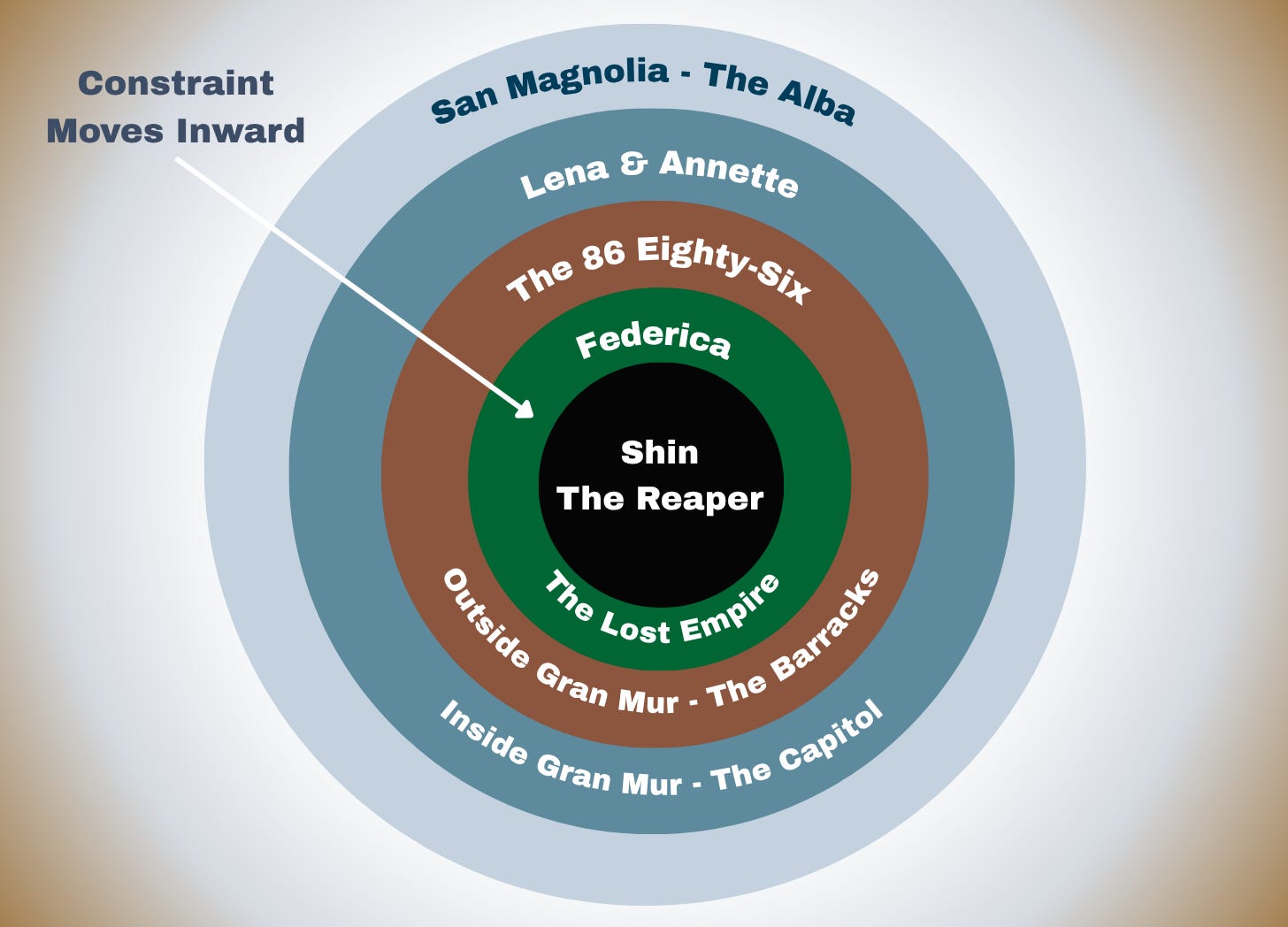
Beyond the questions about the truth, 86 Eighty-six poses questions regarding choice and the exercise of agency, in particular for the Alba. Everyone is born knowing that all humans have equal rights regardless of their origin. It’s the tainted lens that society manufactures which makes us view those different from ourselves, or judge others by a fabricated purity standard as “less” or “outsiders”. Delivered through both mass media and our influential formative inner circles, propaganda limits the ability to perceive others clearly and without bias. While pressured by their circumstances to conform, choice is still an option, especially for those with the privilege of Alba “purity”. The extent that the characters allow themselves to be manipulated by the San Magnolia superficial definitions and propaganda, divides them from each other and the core of humanity within themselves.
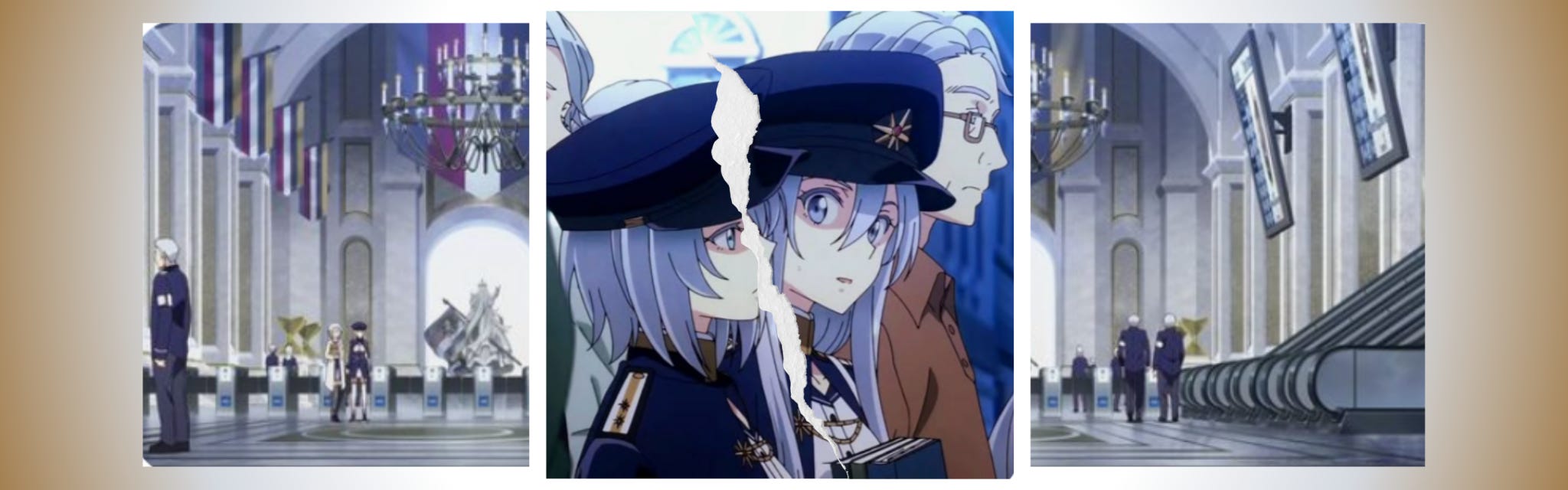
Lena’s point of view directly shows us this, whether waiting at an intersection or walking through the Capitol building: whenever she looks upward, she sees a screen spreading televised propaganda about the war, and boasting its zero casualty success. Around her is a clean city with boisterous crowds of people, but the visible homogeneity of the Alba reflects its narrowly defined perspective. This fragile veneer of purity barely conceals the underlying rot, because their safety is ensured by their complicity in incremental mass murder. While Lena eventually gains the strength and honesty to breach both these constructs and the physical walls of San Magnolia, it required the departure of the Spearhead squadron into the unknown at the calamitous arrival of overwhelming Legion forces at the Capitol. This severing of her bond with the Spearhead Squadron forces for her to finally step into her destined new role as the “Bloody Queen” of San Magnolia, a title that better suits her sovereign power, near maternal protectiveness of her 86 Eighty-Six troops, and ruthless pursuit of victory over the Legion.
Yet, at the stifling core of societal, military and interpersonal constraints, Shin’s role as the “shinigami”, the Reaper, is the one for which there appears no escape. Entrusted with the burden of ensuring that none of the fallen Eighty-Six from the Spearhead’s squadron are absorbed into the Legion, he finds himself forever being left behind. As he carries more and more of the code names cut from their Juggernauts and hears an unrelenting cacophony of their voices, his ties to the living become increasingly fragile. As the pursuit of the rail gun becomes superimposed with Federica’s own story of exile and her knight’s abandonment, the ghostly existence Shin lives amongst his comrades is undeniable. When Lena comes upon him, his wish for death is rooted in not only his weariness, but his despondent sense of loneliness; Shin believes he has finally become the last of his squadron left with no one to keep him from being collected by the Legion. Lena’s presence is a comfort, but it is the voices of Theo, Raidan, Kurama, and Anju, as well as Wenzel and the President, that restore a meaningful role for him within the broader story of the war and its allied forces.
THE PROPAGANDA DIVIDE
As an extension of these constraints, 86 Eighty-Six presents the viewer with a set of contradictory attributes for its characters, stemming from the false identity assigned by the propaganda, and those that originate from within the characters as they adapt to the restrictive dynamics of their respective roles. Everyone in 86 Eighty-Six has a role that both constrains them and offers them choices. The extent to which each has autonomy is reflected in both in the built environment around them, and in the degree to which they have freedom to think. The visual cues of any given scene provide the contrast between the nearly colorless San Magnolia, empty of its own ideas, and the verdant countryside of the Eighty-Six’s barracks, rich with an appreciation for each and every moment they remain alive.
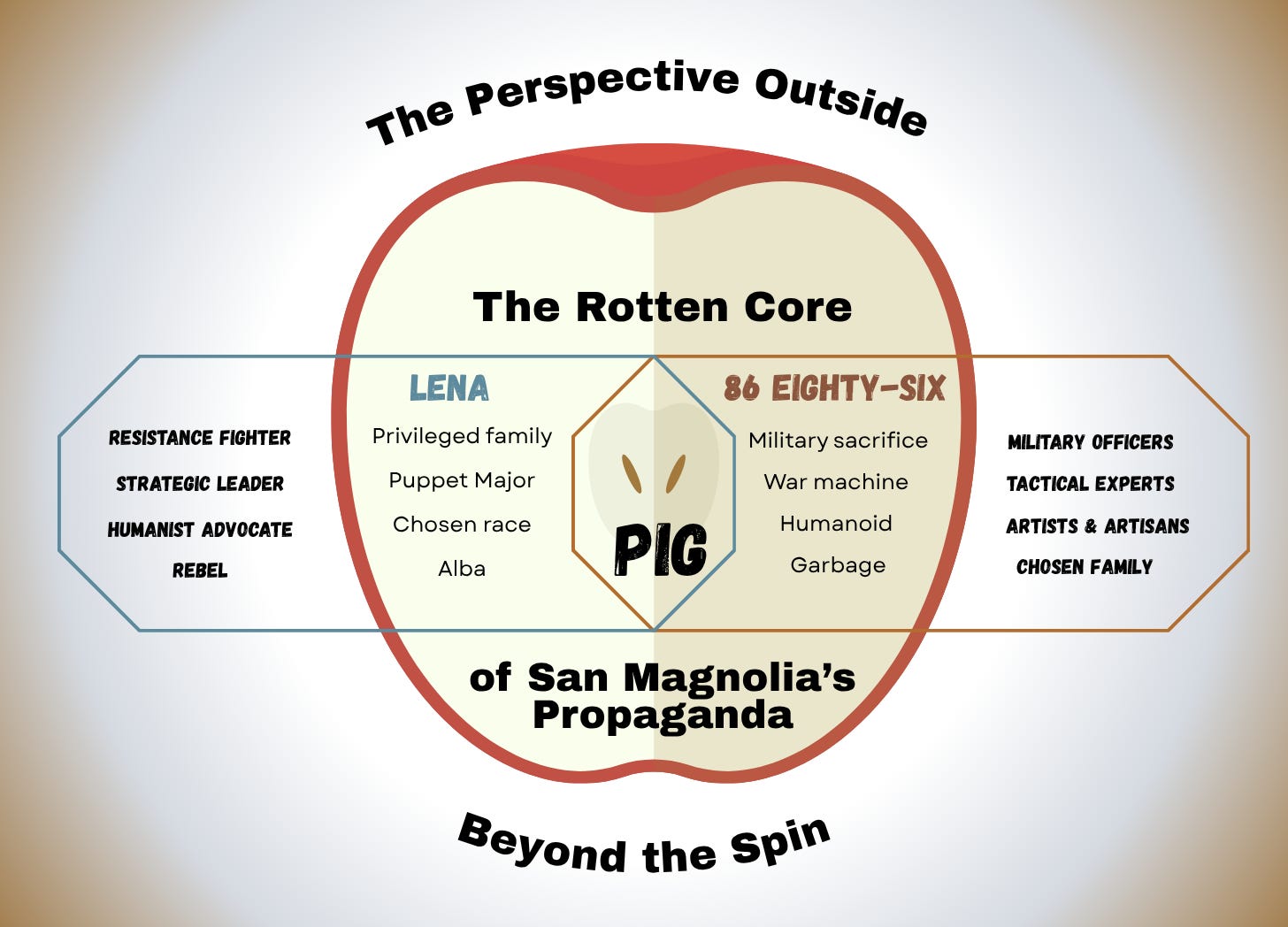
For Lena, her official role as an Alba from a privileged family, with access to the entitled status of an early officer promotion, is tainted by the assumption she will fill the role of a “puppet” Major, compliant and subservient to the propaganda by the Alba government. In many ways, Lena is also a “throwaway” like the Eighty-six, in that nothing is formally expected of her in terms of military tactical success by her superiors. Yet, from this position of minimal expectation, Lena digs into what her innate moral compass tells her is the right action, even if her initial efforts turn out to be inconsequential when the Eighty-six give her a harsh dose of reality. Her initial niceties and attempts to humanize them through conversation proves inadequate to this battle-worn regiment, and simply saying she recognizes them as human is trivialized by the Eighty-six without consideration for the fragility of her feelings.
The death of Kirschblute becomes Lena’s turning point. Rather than collapsing under the weight of her mistakes and the Eighty-six’s mocking derision, Lena redoubles her efforts to support the Eighty-six. By digging deeper into the morass of San Magnolia’s short-sighted military strategy, Lena sends the Eighty-six supplies and support in violation of her orders and limited jurisdiction. By not allowing the failure of any single battle or official rejection of her requests to thwart her, she becomes a true actor in the resistance against the discriminatory policies towards the Eighty-six. Almost ironically, her open recognition of the Eighty-six as humans renders her to the most effective military strategist against the consciously evolving Legion army. When the legion finally breach the Gran Mur wall, San Magnolia is forced to reintegrate the Eighty-six to save the Capitol.
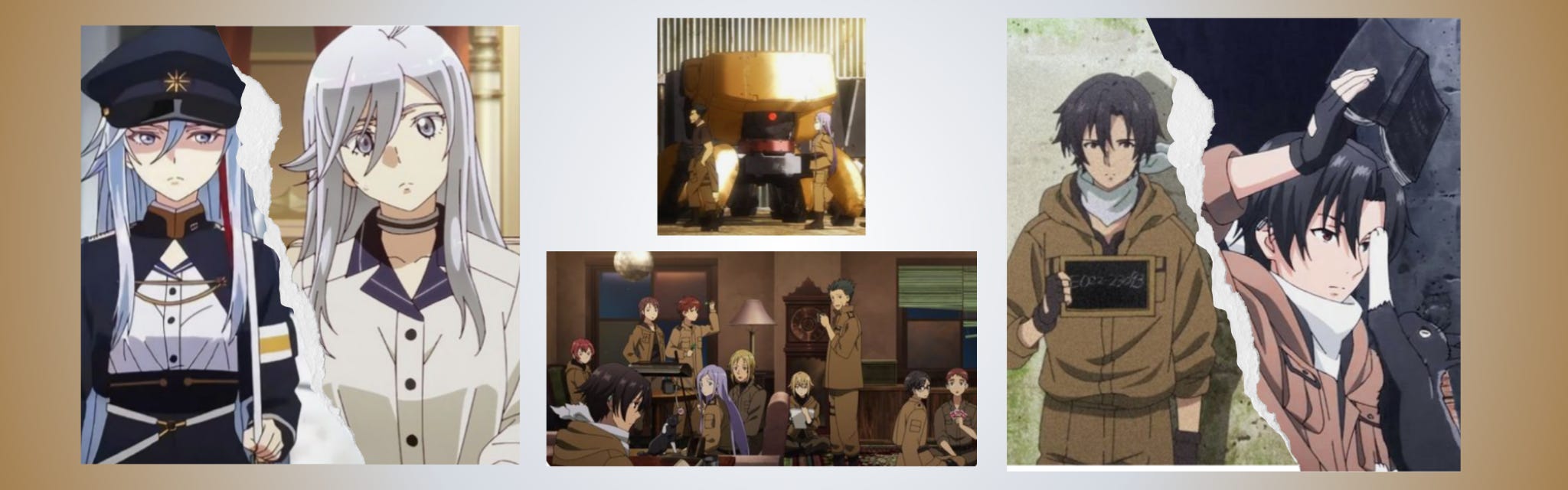
For the Eighty-six, their official role lacks any nuance regarding who they are, where they are from, or what their purpose is; they have been stripped of any acknowledgement that they are human. With the label of “autonomous” assigned toe Juggernauts’ capabilities, the only concession the Alba government makes to an even quasi-living creature being engaged in battle with the Legion is to refer to a synthetic, pig-humanoid hybrid operating the controls of these singular military fighting machines. Built for high speed and agility with no regard for comfort or safety, the Juggernauts’ design forces the Eighty-six into an extremely reckless and dangerous engagement style against the Legion army with multiple different military vehicles, each built fit to purpose. The purpose of the Juggernauts is much more simplified: defeat the Legion through a grievous war of attrition, and murder its own forces through negligence and hazardous conditions. When a government has no regard for the human life it sends into war, its investment in protective technology is obliterated. The Eighty-six go into battle without so much as a helmet.
Their humanity, however, is not wholly unprotected. The Eighty-six may range in their positions regarding the Alba based on their personal experiences, but their sense of themselves within their roles point towards the recognition of their agency in self-determination. It is for themselves to define their purpose in the war beyond the labels and situations the Alba forces on them. They recognize the genocidal blindness of the Legion’s human destruction, giving them as much reason to fight as the Alba. While the devastating inequity in this fight both enrages and embitters the Eighty-six towards the Alba, it does not preclude them from finding their own meaning in their sacrifice, and exerting their own military strategic prowess with Lena based on their advanced experience. Similarly, the poverty of their living conditions does not prevent them from their broader cultural development in themselves through their social relationships, artistic endeavors, and intellectual pursuits.
For Annette in San Magnolia, her role as the objective scientist becomes a protective mask covering the acceptance of her own learned helplessness against the societal forces that shape her segregated and sanitized world. She accepts her own dehumanized role as a cog in the machine by not applying her talents and familial scientific legacy as extensively as she could against the Legion. In contrast to Lena, she resists taking any action to acknowledge the encroaching threat or empower the Eighty-six on the battlefield, and hides behind the cover San Magnolia’s propaganda provides to avoid her own active contribution in the exile of the Eighty-six from her neighborhood. She makes no attempt to resist the unethical military campaigns the Eighty-six are driven into, or to draw upon her innate awareness that the Eighty-six aretreated unfairly for the convenience of society. It isn’t until she is forcefully confronted by Lena with her culpability in the exile of Shin’s family, her own childhood friend, that the fate of the Eighty-six becomes personal enough for her to support Lena’s acts of rebellion. This chink in the mask, though small, begins to let the cleansing light of authentic witnessing into Annette’s perceptual field; this first step in redemptive action causing the brittle rigidity of San Magnolia’s propaganda to crack.
FREEDOM BY RESISTANCE
Your noble friend will not accept pretension, but will gently and very firmly confront you with your own blindness. Such friendship is creative and critical; it is willing to negotiate awkward and uneven territories of contradiction and woundedness.
John O’Donohue, Anam Cara: A Book of Celtic Wisdom
Whether it be Lena challenging Annette to resist the strictures of San Magnolia, the Eighty-six challenging Lena to expand her awareness of how to humanize them, or the Federacy challenging the Eighty-six to embrace a future beyond being a machine of war, all of these confrontational interactions promote the further dissolution of San Magnolia’s propaganda both culturally and psychically. Each group must acknowledge reality for survival in their respective high pressure environments: they must admit and correct their narrowed vision with varying degrees of blindness. Their emergence from behind this distorted lens can only be accomplished through interrogations of what they have believed was right and justified to this point.
The core of these interrogations is to challenge fundamental ideas around the existence and value of purity. In particular, the ethnic purity of the homogenous Alba versus the “mixed” Eighty-Six; but also the purity of adhering to a singular role (being a soldier) or identity within that role (being the Reaper). In all of these cases, the notion of purity stunts and stagnates the people in envelopes in its restrictive limitations. The eventual rot and disintegration of critical humanistic aspects result in the colorless Alba society and the futureless Shin. It is a paradox that the singular purity that proves limitless and expansive is the purity of heart that recognizes the inherent humanity beyond socially-imposed role or identity. Perhaps it is not an accident that we see over and over in 86 Eighty-Six the vantage point of children and childhood memories when this purity needs to be tapped into for the strength to resist the toxic cloud of propaganda encompassing all of the characters. .
With their experiences of childhood purity and innocence, the propaganda faces a limited temporal existence. In an ironic twist, the belief in the near-future obsolescence of the Legion was actually San Magnolia seeing its own future: the dissolution of the “pure” Alba society. As the Legion expanded its intelligence through the incorporation of the Eighty-six, so too the Republic of San Magnolia began its own societal evolution with the breaching of the Gran Mur Wall, and the reincorporation of the Eighty-six into their society. But the war is far from over at the close of 86 Eighty-Six, making this story not about victory over evil, as much as about restoration: restoring the team together, restoring Shin’s humanity, and restoring the Eighty-six to legitimate members of society. With this restoration, we witness the disintegration of dehumanizing labels (“pig” and “monster”) that express an identity based on roles alone. What emerges is a holistic awareness that encompasses the complexity of courageous, fragile people, hopefully striving to be fully embraced despite the calamitous conditions of their lives.

Leave a comment and let us know what you think! And feel free to share other anime that are similar or that you would like us to write about at The Window Seat Anime Journal. Thanks for reading!
The Window Seat Anime Journal was created to provide a “book club” experience for anime content by introducing people to new anime and providing a forum for the deeper thematic exploration that all great anime truly deserve.
Make sure to subscribe and never miss a post!
Did you enjoy reading a long essay? You can find other long essays at our Substack website, including this dark fantasy story about a journey towards self-determination in Dororo:

The Window Seat Anime Journal publishes both spoiler-free “Snapshots”, and long essays for those who want to a deeper exploration of its themes. Make sure to subscribe and never miss a post!

You can view our entire collection of writing on our Substack website at:

Wow! Your essay is jam-packed with the breadth and density, and the many uncomfortable contradictions, that oppress the characters and their worldviews in 86. I also appreciated your unique diagrams to visualize these larger systems of influence, choice, and propoganda--I love seeing (and making) bespoke images like that!
You've clearly refined your thoughts on this series, and that meticulous attention and care shines in how you expand and contract from the inner- and outer-worlds of the characters. I particularly loved the section where you outline the limits of Lena's misunderstanding of the type of "humanity" and compassion she can offer her squad. They don't need her ideals and polished moralizing: they need resupplied and a clear exit strategy.
The evolution of truly listening and responding to the needs of others is what Lena's turn emphasizes. Power structures may not fall immediately from these small actions, but if even a single other person sees this edifice shake in place from your own radical empathy, a message can spread. Minds can change, then novel words, tools, and countermeasures can follow. Sometimes, utilizing the privilege and status we have to break rules is the only path to ensuring trust is leveraged toward the truer task: restoring connection through reform, not adhering to psychically damaging propaganda, either internally recycled, socially mandated, or both.
Thank you for such a stimulating, all-encompassing look at this show! I'm more convinced than ever to get to the final episode.