

86 EIGHTY-SIX
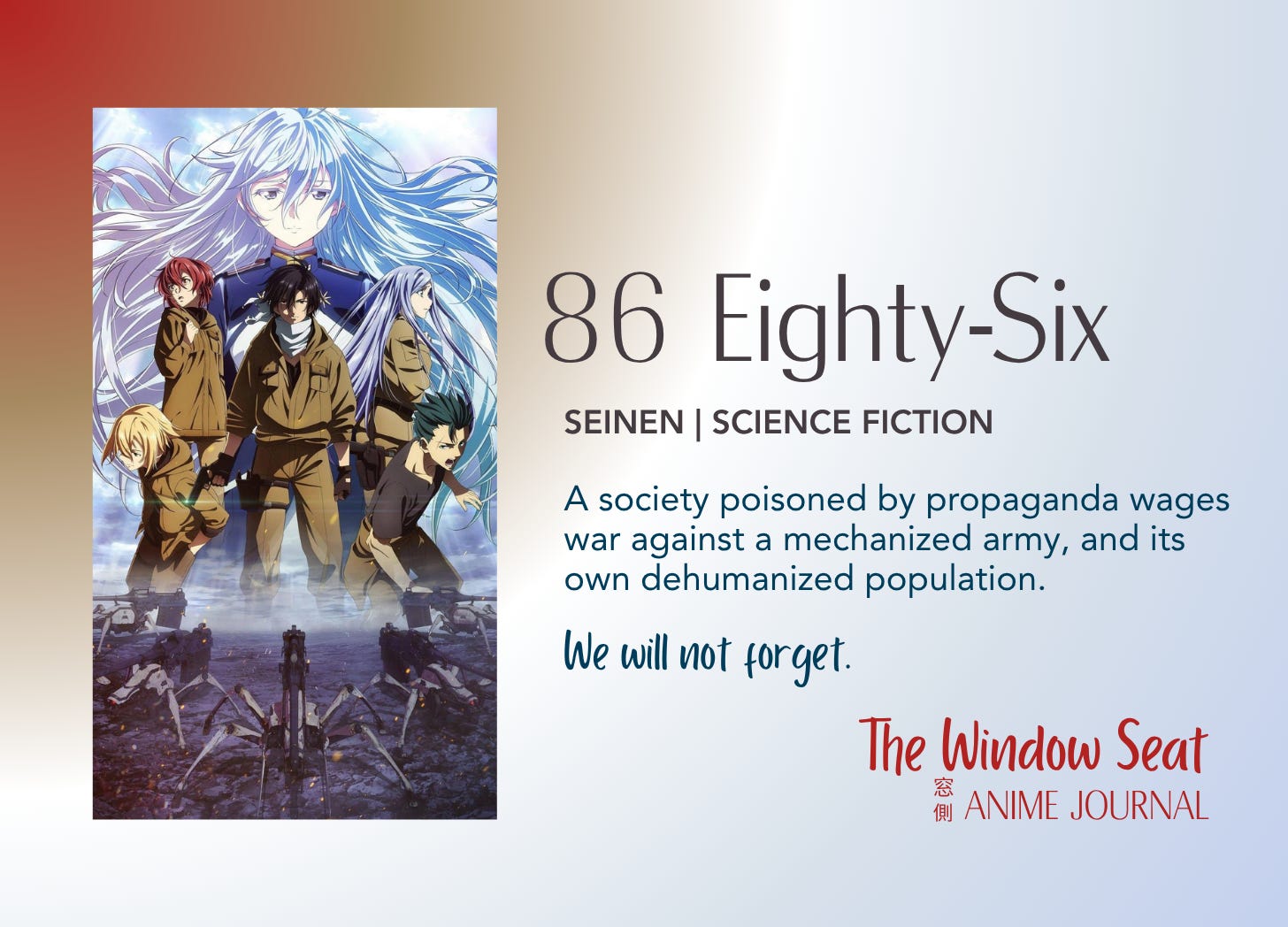
A society poisoned by propaganda wages war against a mechanized army, and its own dehumanized population.
OVERVIEW
In 86 Eighty-Six, the Republic of San Magnolia, and its homogenous population of silver-haired and blue-eyed Alba, is waging a war beyond its reinforced walls against a fully autonomous and mechanized army from the Empire of Giad, called the “Legion”. The inhabitants of San Magnolia are unperturbed by this conflict, as their own autonomous force of “highly advanced mechanized drones”, the Juggernauts, handles all the fighting, resulting in zero casualties to the Alba population.
But this is a lie. The Juggernauts are neither autonomous nor mechanized; they are manned by the human “Eighty-Six”, the non-Alba population previously purged from the Republic. Exiled beyond the Gran Mur wall to the camps of District 86, they’re forced into lethal battle with the Legion, regardless of their age or ability. Under the dehumanized title of “Processors”, the Eighty-Six fight the Legion continuously until their inevitable death, with their corpses abandoned to rot on the battlefield. Believing the Legion army’s technology has an obsolescence date only a few years away, the Republic is unconcerned about the totality of the Eighty-six attrition. In fact, the Alba public are told that the Eighty-six are synthetic, pig-like creatures that only mimic humans, and whose existence is wholly disposable. These illusions blind them to the true consequences of their ignorant cruelty and thoughtless dehumanization of the Eighty-six: the Legion is consciously evolving and the war is far from over.
Enter Major Vladilena Milize (Lena), who is promoted to be the Handler of a unique group of highly successful Juggernaut Processors. In this role, Lena meets the elite Spearhead Squadron, led by a Processor with the Alba code name, “Undertaker”, but known by the Eighty-six and their previous Handlers as “the Reaper”. The Spearhead Squadron is entirely composed of Eighty-six who have managed to survive for years on the battlefield fighting the Legion. Unbeknownst to them, Lena is no ordinary Handler: she acknowledges that the Eighty-six are human, and refuses to refer to them as anything else, especially not as “pigs”. But the Eighty-six are not so quick to return the favor, calling her the “white pig” at every slip and error. They have little reason to put faith in her: Lena will be the Spearhead Squadron’s seventh Handler over Undertaker, because all previous handlers retired, requested to transfer, or committed suicide.
As both sides learn more about each other, Lena, through her inexperience and flawed thinking, realizes and accepts her own hypocrisy and culpability in the society of the Alba. In turn, the Eighty-Six accept that they can either trust her intentions and recommended strategies, or fight the Legion without any support or recognition for their sacrifice. When the grimness of their shared fate is eventually revealed, along with the inexorable advancement of the evolved Legion forces towards the capitol of San Magnolia, they all must choose new directions, new allegiances and new war strategies to ensure humanity’s eventual victory over this seemingly indestructible foe.
Note: The Autonomous Mechanized Legion
The types of Legion military are given in episode 2, but are provided here to help with the learning curve:
Eintagsfliege: flying radar jammers
Amiese: Scouts
Grauwolf: Dragoons
Lowe: Tanks
Skorpion: Long range gunners
There are also the Shepherds and the Black Sheep, but those would be spoilers beyond this summary. And you meet them soon enough!
ANIMATION STYLE
Within the first minutes of this anime, the viewer is pulled into the high intensity action of the battles with the Legion, the acrobatic fighting maneuvers of the Juggernauts, and the stream of racist invective coming from their Handler.
And then his screams.
However, this battlefield intensity is not the main setting or pace for the majority of scenes. One of the strengths of 86 Eighty-six is the contrast and balance across different settings, activities, and moods. This anime deftly moves the viewer between the perspectives of Eighty-six from within their Juggernauts during battle, to Lena’s bedroom of quiet luxury within the bustling streets of San Magnolia, to the sparse outlying barracks where the Eighty-six live. High-paced, nail-biting action scenes of Legion battles are combined with low-speed, slice-of-life scenes at the Eighty-Six barracks, and of Lena struggling in the sterilized political world of San Magnolia, where the peaceful and orderly surface appearance covers the rot of propaganda, racism, and entitlement that pervades the Alba government and society.
Even in battle scenes, the visual contrast is high; the filthy and beat-up Juggernauts are juxtaposed against the shining Legion, who never appear any worse for wear no matter how ferociously the Eighty-six fight them. Despite the advanced military technology, 86 Eighty-Six does not feel entirely futuristic due to the way the natural world continuously inserts itself into the scenes, whether in the background or into the military technology itself. The striking similarity between the appearance of the military machinery with the carapaces of insects (Legion and Juggernaut alike), and the way they maneuver reflects this pervasive intersection between the natural world and the human (or Legion) designed technology of war.
Ambient lighting also plays a strong role in the visual impact of this anime. Despite its heavy wartime theme, this anime includes a striking amount of sunlight across the scenes: brightly streaming, filtered through clouds, rising at the beginning or declining at the end of the day, giving viewers a subtle nod towards the hope of a possible new dawn amidst all the pain and loss endured by the Eighty-Six.
By balancing these different elements of pacing, lighting and the inclusion of the natural world, 86 Eighty-Six creates the space for deeper and meaningful engagement with its weighty material, by letting the viewer “reset” to a different pace or setting, creating exquisite contrast. But there is no true lull in the tension; 86 Eighty-six doesn’t spare every life, and you never know who, if anyone, will return after a mission.
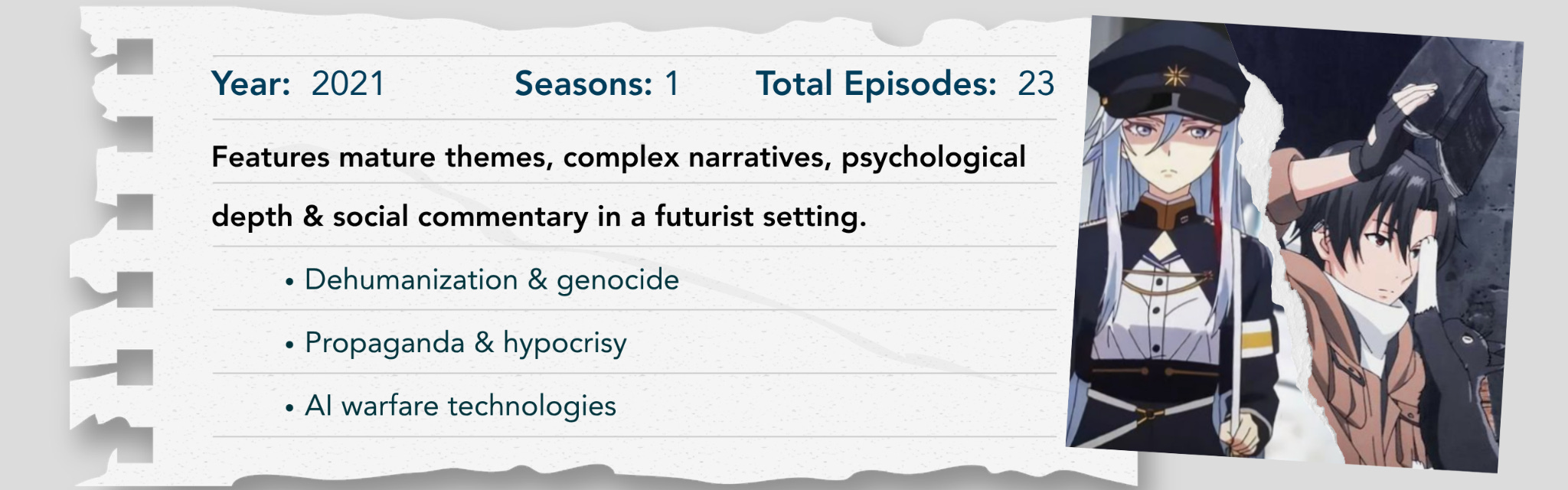
All of this variability delivers a story that is complex in a very compact way. Though only 23 episodes, there is plenty of time to show all of the action from dual perspectives, both of the Eighty-Six and Lena in the Republic, plus plenty of slice-of-life scenes, flashbacks, and cutaways to nature. Because of this, it never feels rushed or hectic, but presents all of the characters, relationships, plot elements, and themes in a deep and thorough way.
Every second is meaningful, and you want to always watch through the closing credits, as there are many additional scenes at the end, some of them with intense emotional impact. There is no “throwaway” material in 86 Eighty-Six!
TARGET AUDIENCE
The target audience for 86 Eighty-six enjoy anime based on historical events with a science-fiction twist, political and military stories, and those that deliver strong social commentary about dehumanization, classism and bigotry. Fans of 86 Eighty-six would be described as intellectual and humanist, have a strong sense of justice, are interested in the intersection of AI technology and human consciousness, and like to play strategic and/or military games.
OPENING, CLOSING & MUSIC
86 Eighty-Six has a strong opening that showcases the complexity of the series, as it shifts between fighting with the Legion, slice of life at the barracks, and political leaders pontificating. The opening sequence for the first eleven episodes includes the song 3 min 29 sec by Hitorie.
The opening for the second half shifts with the trajectory change to highlight the losses and connection by the Eighty-Six, and the intensified battle campaigns against the Legion. This evolved story arc showcases the song Kyoukaisen by amazarashi.
It also has three distinctive songs from SawanoHiroyuki[nZk] that you will want to put on heavy rotation after you watch this anime:
Avid (featuring mizuki)
Hands Up to the Sky (featuring Laco)
The Answer (featuring Laco)
If there is other music in this anime that grabs your attention (and heart!), you can also look for the full 86 Eighty-Six original soundtrack with music by Hiroyuki Sawano and Kohta Yamamoto.
Be sure to find all of these songs on your favorite music streaming!
Ready to watch 86 Eighty-Six? We are sad to say that it lost its licensing in early 2026 on both Crunchyroll and Netflix.
We hope the dedicated fanbase for this lesser known anime helps it return to legitimate streaming soon.
SIMILAR ANIMES
86 Eighty-Six delivers a tremendous amount of plot, action, and thematic content in just 23 episodes, enabling it to stand side-by-side with some of the most epic anime. If you have already seen these heavy-hitters and liked them, then you need to put 86 Eighty-Six at the top of your watchlist:
Full Metal Alchemist: Brotherhood for broad social commentary and fighting against a seemingly undefeatable enemy; the bond between military partners, the impacts of trauma on the psyche; the political implementation of dehumanization and exclusion.
Attack on Titan for intense war, military strategy, propagandist power, and fighting an insurmountable enemy who is not what it seems. It also boasts one of the highest ranked soundtracks and scores.
Gachiakuta for the class power dynamics and the separation of societies into the privileged and the discarded; lack of fair rule of law leading to false accusations by the power class and lethal exile of the undesirable; and the ability of skilled fighters to transform items in such poor condition they should be ineffective in battle into advanced killing machines to bring down inhuman enemies.
Dororo for questions around dehumanization and the sacrifice of the one for the many; for the ability of the pure heart to see past an atypical surface appearance that has been designated as inhuman; and for the powerful bond of the chosen family.

SOURCE MATERIAL AND ANIME PRODUCTION
From Wikipedia: 86 Eighty-Six
LIGHT NOVELS
The light novels are written by Asato Asato and are illustrated by Shirabii, with mechanical design by I-IV. ASCII Media Works has published fourteen volumes since February 2017 under their Dengeki Bunko imprint. The light novels are licensed in North America by Yen Press, which has published 13 volumes as of December 10, 2024.
MANGA
A manga adaptation by Motoki Yoshihara was serialized in Square Enix’s seinen manga magazine Young Gangan from February 16, 2018, to June 2021. On July 6, 2022, it was announced the manga was cancelled due to Yoshihara’s health issues. Its chapters were collected in three tankōbon volumes. It has been licensed in North America by Yen Press.
ANIME
An anime television series adaptation was announced in a livestream commemorating the first anniversary of Kadokawa’s “Kimirano” light novel website on March 15, 2020. It is produced by A-1 Pictures and directed by Toshimasa Ishii, with Toshiya Ōno writing the scripts, Tetsuya Kawakami designing the characters, and Hiroyuki Sawano and Kohta Yamamoto composing the music. The CGI will be developed by Shirogumi. The series is a split-cour anime, with the first half airing on Tokyo MX and other stations from April 11 to June 20, 2021.The second half aired from October 3, 2021, to March 19, 2022.

The Window Seat Anime Journal publishes both spoiler-free “Snapshots”, and long essays for those who want to a deeper exploration of its themes. Make sure to subscribe and never miss a post!


I really enjoyed reading this. What stayed with me most wasn’t only the themes of war or discrimination, but how carefully you showed that 86 is ultimately about recognizing another person’s humanity.
I also loved your observations about the contrast between intense battle scenes and moments of quiet. Those peaceful moments made the emotional weight even stronger.
Thank you for another thoughtful essay. 💜
This is a beautiful and deeply insightful review! You completely captured the essence of 86 Eighty-Six. The final episode gets me emotional no matter how many times I rewatch it. As an anime fan, I especially love how you highlighted the brilliant soundtrack. The way Hiroyuki Sawano's music elevates the desperate struggle of humanity against an overwhelming, absolute threat is just masterful—much like his work in Attack on Titan or Aldnoah.Zero. The premise of 86 actually reminds me of classic Japanese sci-fi masterpieces that depict humanity on the brink against an absolute enemy, like Zegapain, Fafner in the Azure, Muv-Luv Alternative, and Gunparade March. For anyone who loves that deep, high-stakes military tension, 86 is an absolute triumph. Thank you for this incredible write-up! 🎧🔥